

Updated on November 26, 2025
Written by The Wealthy Gigster Team
Edited by Kevin Nishmas, Managing Editor
At a Glance
This online 60/20/20 budget calculator is built for gig workers, freelancers freelancers, independent contractors and the self employed with unpredictable income. It’s a free tool that helps you budget your money according to the 60/20/20 budget rule: 60% for essentials, 20% for taxes and 20% for financial goals. It provides an easy way for you to manage inconsistent income, avoid tax surprises and build financial stability—without spreadsheets or confusing jargon.
Table of Contents
- Key Takeaways
- Why Should Gig Workers Use a 60/20/20 Budget Calculator?
- What’s the 60/20/20 Budget Rule (and Why Did We Build Our Calculator Around It)?
- Who Should Use the 60/20/20 Budget Rule (and Our 60/20/20 Budget Calculator)?
- How to Use Our 60/20/20 Budget Calculator
- Real-World Math: Budgeting on $1,500/Week
- Think You’re Messing Up the 60/20/20 Rule? You’re Not.
- What are the Best 60/20/20 Budget Rule Tools?
- Final Thoughts
- Frequently Asked Questions (FAQs)
Key Takeaways
- The 60/20/20 budget calculator helps gig workers, freelancers, independent contractors and solopreneurs budget using their weekly take-home income
- This online calculator shows how to divide your income into 60% for essentials, 20% for taxes and 20% for financial goals
- If your income is irregular, use a four-week average to smooth things out
- Weekly budgeting makes it easier to manage cash flow and avoid month-end panic
- The 60/20/20 budget rule is flexible (you can shift the percentages to fit your real expenses and goals)
- Financial goals might include saving for emergencies, paying off debt or investing in your business
- Tools like Rocket Money, Keeper and CIT Bank can help automate and track your spending
- You don’t have to hit the 60/20/20 budget rule targets perfectly (this is a framework, not a financial report card)
Why Should Gig Workers Use a 60/20/20 Budget Calculator?
Budgeting when you’re a gig worker, freelancer, independent contractor or solopreneur is like trying to nail jello to a wall. It’s nearly impossible and messy as hell, unless you’ve got the right tool for the job. Our free 60/20/20 budget calculator is built for the financial chaos that comes with ups and downs of gig income.
This flexible budgeting tool is perfect for gig workers and freelancers who don’t get a steady paycheck. If your income is more rollercoaster than salary ladder, our 60/20/20 budget calculator will help you figure out where your money should ideally go.
Instead of pretending you bring in the same amount every week, this calculator starts with what actually lands in your account—your real, after-tax, take-home pay.
Whether that’s $850 this week and $1,200 next, or the other way around, you can plug in your weekly income and get a realistic breakdown that helps you stay afloat, tax-ready and on track.
So, you don’t need spreadsheets to do the job. Our 60/20/20 budget calculator offers you a smart, no-BS way to divide your cash into three simple categories: essentials (60%), taxes (20%) and financial goals (20%).
Why You Can Trust The Wealthy Gigster
We don’t do fluff. And we definitely don’t let advertisers tell us what to say. Every product or service we recommend is vetted using real data, independent research and the financial chaos test: “Would this product or service actually help someone with an irregular income and a rent deadline?”
We rate tools and services based on what matters to gig workers, not 9-to-5ers. If we earn a commission from a partner, you’ll know—but our opinions stay brutally honest, no matter what.
Want the receipts? Check out our About Us, Editorial Standards and Advertising Disclosure pages for how we work and what makes our recommendations worth your time (and money).
What’s the 60/20/20 Budget Rule (and Why Did We Build Our Calculator Around It)?
When you’re self-employed, budgeting off weekly paychecks you don’t actually get is useless. The 60/20/20 budget rule gives you a flexible, percentage-based system that adjusts to your real income, no matter how messy or inconsistent it is. That’s why our calculator is built around it—and why it tells you exactly what to put toward essentials, taxes and financial goals.
Our free 60/20/20 budget calculator is based on the 60/20/20 budget rule, a flexible money management system made for gig workers, freelancers, independent contractors and the self-employed with unpredictable income.
Whether you’re juggling freelance gigs or side hustles, this tool helps you split your weekly take-home pay into 60/20/20 budget rule’s three simple spending categories. Here’s how it works:
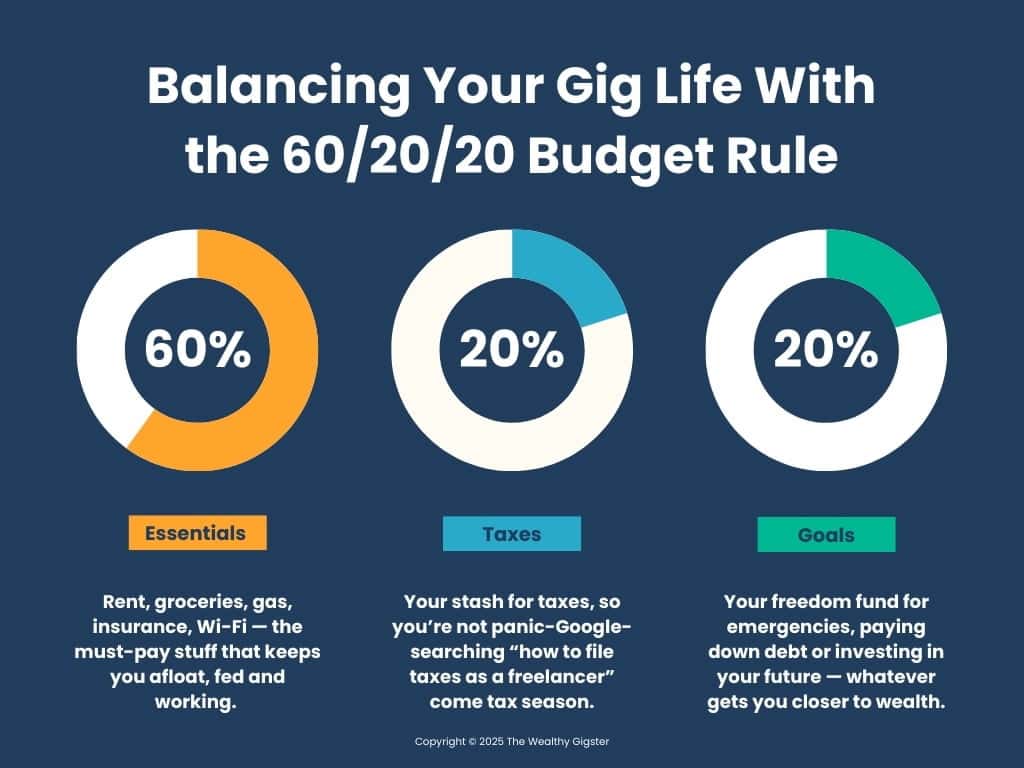
- 60% for essentials: rent, groceries, gas, insurance, phones and everything else that keeps the lights on
- 20% for taxes: income, self-employment and state taxes (so you don’t get blindsided when the IRS comes knocking)
- 20% for financial goals: saving for emergencies, paying down debt or investing in your future self
Unlike traditional monthly budgets that assume a stable income or a corporate paycheck, the weekly 60/20/20 budget rule is built for the feast-or-famine cycles of gig and freelance life. You can use your actual weekly income—or a four-week average—to see exactly how much to set aside for each bucket.
Who Should Use the 60/20/20 Budget Rule (and Our 60/20/20 Budget Calculator)?
If your income changes from week to week, you already know traditional budgeting doesn’t cut it. The 60/20/20 budget rule gives you a simple, percentage-based system to make sense of your financial chaos — and our free calculator does the math for you, so you can stop guessing and start planning for better days ahead.
The 60/20/20 budget rule and our 60/20/20 budget calculator are built for these types of gig workers:
- Freelancers and side hustlers – Writers, designers, developers, consultants — anyone juggling multiple gigs or income streams
- Platform-based earners – Rideshare and delivery drivers (Uber, DoorDash, Instacart), TaskRabbit pros, pet sitters and Airbnb hosts
- Independent contractors – Solopreneurs, Etsy shop owners, online sellers and service providers with fluctuating revenue
- Anyone with unpredictable income – Contract educators, creatives, seasonal workers, part-time earners or anyone without a regular paycheck
If you’ve ever been blindsided by a tax bill, put off saving because the cash wasn’t there or wondered where your money should go—the 60/20/20 budget rule is for you.
Even better, our 60/20/20 budget calculator makes it easy to break down your weekly income into clear, actionable amounts for essentials, taxes and financial goals. No spreadsheets. No overthinking. Just a plan to live a richer gig life.
How to Use Our 60/20/20 Budget Calculator
Our 60/20/20 budget calculator does more than just split your income into neat percentages. It gives you a clear picture of how your actual spending compares to the 60/20/20 budget rule — so you can spot problem areas fast.
To use this budgeting tool:
- Enter your weekly take-home income (what lands in your account after taxes, fees and deductions).
- Add what you currently spend each week on essentials (rent, groceries, gas, Wi-Fi), taxes (what you set aside for the IRS) and financial goals (savings, debt repayment, investing).
- Click the “Compare My Budget” button to automatically compare your weekly spending against the 60/20/20 budget rule.
- See if your weekly budget is on target, under or over in each category (and by how much).
- Click the “Download CSV” or “Print” button to save or share a copy of your results.
Tool Tip
If your income is inconsistent, use the average from your last 3–4 weeks. This gives you a more reliable number to enter into the “Your Weekly Net Income” field of our 60/20/20 budget calculator. Let’s get started. It’ll only take a minute.
60/20/20 Budget Calculator
Enter your weekly take-home income and actual spending below to see how your current budget stacks up to the 60/20/20 rule.
Real-World Math: Budgeting on $1,500/Week
Here’s a real example of how our 60/20/20 Budget Calculator highlights what works (and what doesn’t) when you apply the 60/20/20 budget rule to $1,500 in weekly income (after taxes, fees and deductions).
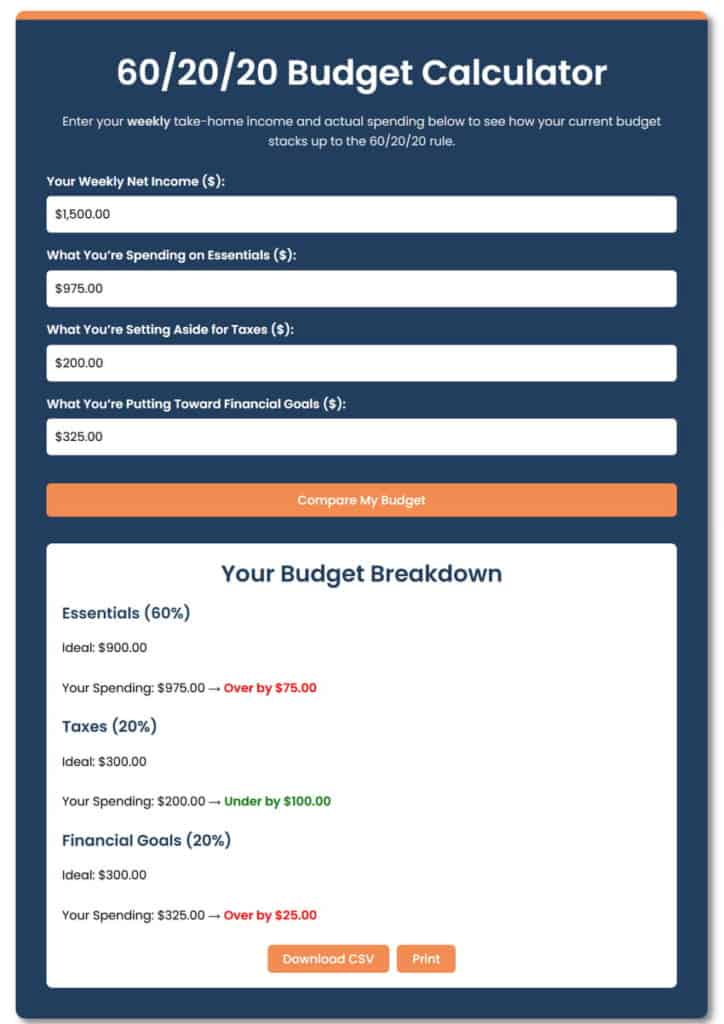
The example clearly shows a case of overspending on essentials and financial goals—and setting aside too little for taxes.
Generally, saving a bit more than the 20% financial goal target is a plus, but the tax shortfall here could lead to trouble down the road—when the IRS comes knocking and wants more than just a friendly chat.
Do you need a reality check on how your spending stacks up against the 60/20/20 budget rule? Our 60/20/20 Budget Calculator lays it all out—so you can see where your money’s actually going and make smarter moves without the guesswork that usually comes with budgeting on an irregular income.
Think You’re Messing Up the 60/20/20 Rule? You’re Not.
Worried your numbers don’t match the 60/20/20 budget rule exactly? Don’t be. This rule isn’t about rigidly sticking to exact percentages. It’s more of a guideline than a hard rule. It’s meant to help you prioritize, not punish yourself.
The 60/20/20 budget rule merely suggests:
- 60% of your income should go to essentials
- 20% to taxes
- 20% to financial goals
But real life is messy—it doesn’t always fit into clean percentages. Remember, the 60/20/20 budget rule is a tool, not a test. You just need to adjust the Essentials, Taxes and Financial Goals buckets to reflect your life—your needs, your goals, your reality. Here’s how to make it work for your situation.
Living with High Taxes
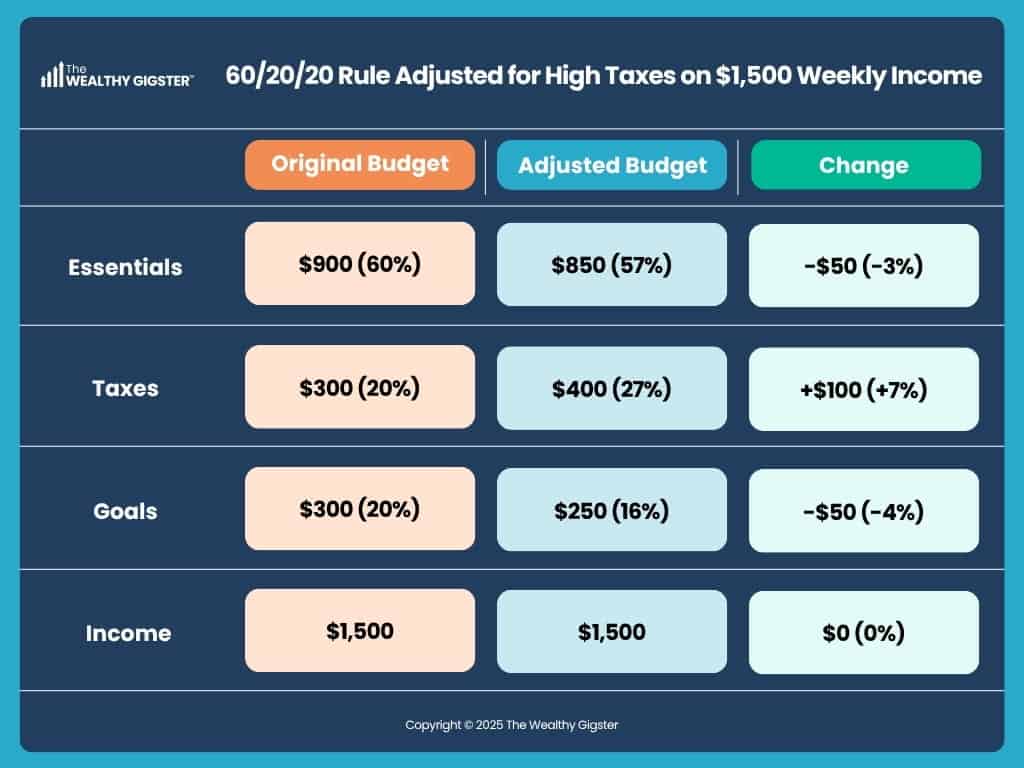
If taxes are high where you live, you might need to allocate more than 20% toward them.
Quick Takeaways
- Taxes jump from 20% to 27%, increasing from $300 to $400.
- To make room, Essentials drop by $50 (from 60% to 57%) and Financial Goals are reduced by $50 (from 20% to 16%).
- Total income stays the same, but the budget gets rebalanced to reflect real-world pressures like a higher tax bill.
Living with High Rent
Housing costs are brutal in many cities. If rent eats up half your income, don’t sweat it—adjust around it.
Quick Takeaways
- Essentials increase from 60% to 70% to account for higher rent, rising from $900 to $1,050 (+$150).
- To balance that jump, Taxes have been trimmed from $300 (20%) to $250 (17%), a $50 decrease.
- Financial Goals take the biggest hit, dropping from $300 (20%) to $200 (13%), a $100 cut.
- Total income remains unchanged at $1,500/week., but the budget gets rebalanced to reflect real-world challenges like high rent.
Living Debt-Free
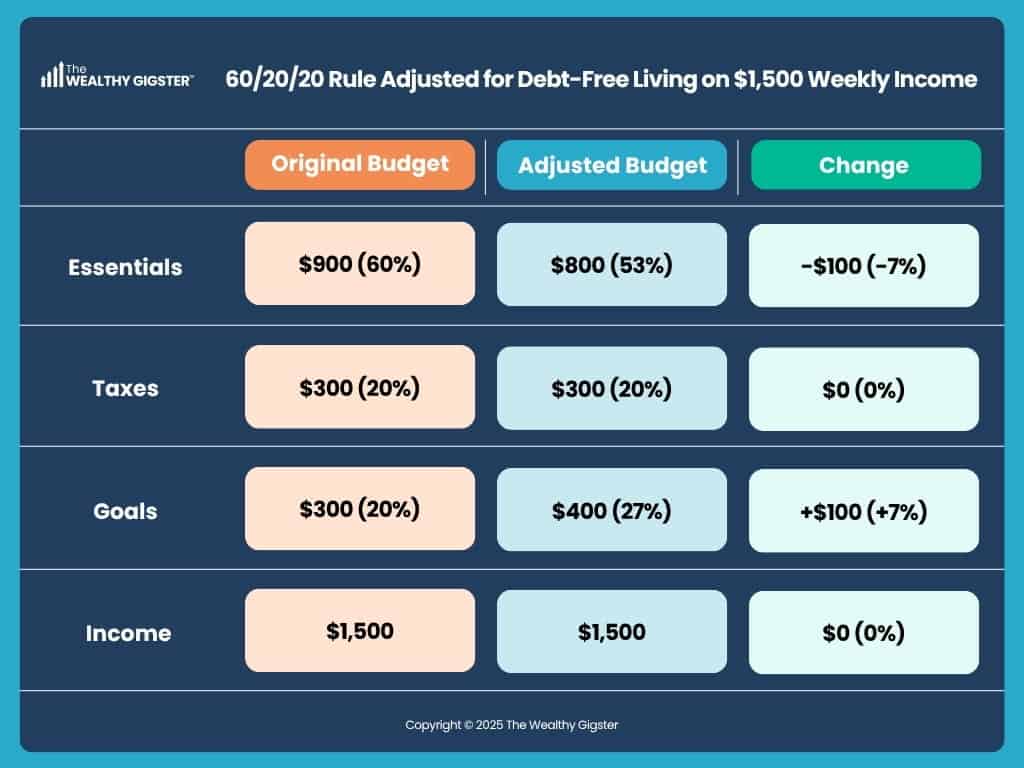
If you’ve paid off debt and have a solid emergency fund, you’ve got more breathing room. You can throw extra cash into your long-term financial goals.
Quick Takeaways
- Essentials are reduced from $900 (60%) to $800 (53%), freeing up 7% of the budget.
- Taxes remain unchanged at $300 (20%), showing that not all categories need adjusting.
- Financial Goals get a boost, rising from $300 (20%) to $400 (27%)—a $100 increase thanks to lower essential expenses.
- Total income stays the same at $1,500/week, but the budget gets rebalanced to prioritize long-term goals, like saving, investing or building wealth faster.
Tool Tip
To plug the right numbers into our 60/20/20 budget calculator, download our free 60/20/20 budget worksheet to track your income and spending.
What are the Best 60/20/20 Budget Rule Tools?
If you’re self-employed or freelancing your way through a cycle of unpredictable paychecks, the right tools can make or break your budgeting game. These apps and accounts can help you automate the 60/20/20 rule—so you spend less time stressing over your budget and more time making money.
To get started, download our free 60/20/20 Budget Worksheet for Gig Workers, a no-nonsense, easy-to-use tool designed to help you apply the 60/20/20 rule week by week—with line-by-line suggestions for what counts in each category.
Automate the Boring Budget Stuff
Apps like Rocket Money and YNAB let you track spending, tag transactions and stick to your budget—without any boring spreadsheets.
Smart Budgeting with Little Effort
Rocket Money automatically tracks spending, identifies subscriptions and categorizes expenses to make it easier for you to follow the 60% guideline for essentials.
Make Tax Season Suck Less
Use apps like Keeper or QuickBooks Self-Employed to track expenses and file your taxes like a pro (and finally stop Googling “what’s a deductible?”).
The All-in-One Tax and Mileage Tracker
QuickBooks Self-Employed tracks your business income, mileage and expenses all in one place, automatically generating ready-to-file tax returns—so tax season feels less like a root canal.
Grow Your Stash While You Sleep
Open a high-yield savings account with SoFi or CIT Bank and funnel your 20% goals money where it’ll actually earn much more.
Grow Your Savings with Perks
SoFi High-Yield Savings comes with FDIC-insured protection, high interest and zero monthly fees, plus lets you set automated savings rules to stay on track with your financial goals.
Earn More on Your 20% “Goals” Money
CIT Bank Savings Connect offers competitive rates to help your money grow faster and smarter—with no fine print, no gotchas, no monthly fees and no minimum balance requirements.
Final Thoughts
Budgeting on an unpredictable income doesn’t have to be a guessing game—or a guilt trip.
Whether you’re a gig worker, freelancer or independent contractor navigating the feast-or-famine flow of unpredictable income, the 60/20/20 budget calculator helps you stay in control—on your terms.
Our free 60/20/20 budget calculator makes it even easier to see where your money’s going—and where it should be going—without the headache of spreadsheets or the pressure to get every percentage “just right.”
You don’t have to follow the 60/20/20 budget rule to the penny. Just use the 60/20/20 budget calculator right here to adjust your buckets to fit your real life and take one more step toward financial stability—on your terms.
Because even when your income is unpredictable, your budgeting doesn’t have to be.
Frequently Asked Questions (FAQs)
What is the 60/20/20 budget rule?
It’s a flexible budgeting rule that divides your after-tax income into three buckets: 60% for essentials (like rent, groceries and gas), 20% for taxes (so you’re not surprised come tax season) and 20% for financial goals (savings, debt repayment or investing).
Why is this calculator based on the 60/20/20 budget rule?
Because this 60/20/20 budget calculator is built for real-life gig income chaos. Gig workers and freelancers don’t get predictable paychecks. The 60/20/20 budget rule flexes with your earnings and helps you keep afloat, stay tax-ready and achieve your goals.
How do I use the 60/20/20 budget calculator?
It’s easy. Just follow these five steps: (1) Enter your weekly net income (after taxes, fees and deductions). (2) Add what you currently set aside for your essentials, your taxes and your financial goals. (3) Hit the “Compare My Budget” button. (4) See how your spending lines up with the 60/20/20 budget rule. (5) Download or print your results. Then, simply adjust your budget to get the most out of this budgeting approach.
How do I calculate my average weekly income?
Add up your take-home income from the four weeks, then divide that amount by 4. That’s your average weekly income—and a good number to plug into the calculator if your earnings are all over the place.
Can I still use the 60/20/20 budget calculator if I’m not a gig worker?
Absolutely. If your income is inconsistent, seasonal or based on contracts or commissions, the weekly 60/20/20 budget calculator can help you budget better than monthly-based systems.
What if I can’t cover the “Essentials,” “Taxes” and “Financial Goals” categories?
When cash is tight, it can be difficult to cover all three categories. Prioritize essentials first (rent, food, transport), then set aside whatever you can for taxes. Anything left can go to your goals. The important thing to remember here is that the 60/20/20 budget rule is a guideline for bringing some order to your chaotic gig income (and chaotic gig life).
Is the 60/20/20 budget rule better than the 50/30/20 approach?
For gig workers? Often, yes. The 60/20/20 budget rule gives gig workers more room for taxes, which makes sense when you don’t have an employer doing the math for you. Plus, it keeps your essentials covered without guilt-tripping you over your “wants.”
What is the difference between financial goals and essentials?
Essentials are all about survival: rent, groceries, insurance, gas—things that keep you going week to week. Financial goals are about the future: saving for emergencies, paying off debt, investing for tomorrow—things that build financial stability (even financial freedom) over time.
Can I use the 60/20/20 budget calculator for monthly income too?
Yes. Just make sure the income and expenses you enter match the same time period—weekly or monthly. We recommend weekly, because it smooths out the income ups and downs that come with gig life.
Do I have to follow the 60/20/20 budget rule exactly?
Nope. This isn’t a budget boot camp. It’s a guideline—not a rulebook. You can tweak the percentages to fit your situation. Rent too high? Tax bill bigger than expected? Adjust the numbers. Just make sure they add up to 100%.
What tools can help me stay on track?
We recommend apps like Rocket Money, YNAB, Keeper and SoFi to make the 60/20/20 budget rule way easier to follow automatically. Check out the section right above for more details on these tools.
Featured Image by Bruce Mars on Unsplash