

Updated on November 30, 2025
Written by The Wealthy Gigster Team
Edited by Kevin Nishmas, Managing Editor
At a Glance
This online budget planner for gig workers is a free tool built for any independent contractor with unpredictable income. It automatically applies the 60/20/20 rule, dividing your weekly earnings into three budget buckets: essentials (60%), taxes (20%) and financial goals (20%). This way, you can see exactly where your gig money should go.
Table of Contents
- Key Takeaways
- Why Use This Online Budget Planner for Your Irregular Income?
- Why This Online Budget Planner Makes Budgeting Easier
- How to Use the Online Budget Planner for Gig Workers
- Free Online Budget Planner for Gig Workers
- Real-World Math: Perfect 60/20/20 Scenario
- There’s an Easier Way to Budget Your Money
- Rocket Money
- Quicken Simplifi
- YNAB (You Need A Budget)
- Goodbudget
- Take Control of Your Gig Life
- Frequently Asked Questions (FAQs)
Key Takeaways
- This free online budget planner for gig workers automatically does the math for you, giving you a clear weekly budget plan without spreadsheets.
- Live totals and percentages update as you type, so you always know how close you are to the 60/20/20 targets.
- Color-coded bars call you out (nicely) when you overspend, helping you fix problems before they become financial fires.
- A built-in grand total check keeps you honest, making sure your income actually adds up (instead of disappearing on you).
- This flexible budget planner adapts to real gig-life chaos, helping you stay on track, even when your weekly income is all over the place.
Why Use This Online Budget Planner for Your Irregular Income?
Use this online budget planner for gig workers to automatically do the math for you. Get automatic 60/20/20 budget breakdowns and a clear picture of where your gig money should go each week.
Budgeting on irregular gig income can feel like juggling water. It’s messy, unpredictable and almost impossible to get right. If you’ve ever tried doing it yourself, you already know how fast the numbers get lost in the shuffle and how quickly unpaid bills can sneak up on you. Trust me, you’re in good company. Plenty of gig workers feel your pain.
According to a recent CFPB Making Ends Meet Survey, 49% of gig workers with variable income struggle to pay their bills, compared to only 37% of employees with steady paychecks. In other words, unpredictable income makes everything harder, especially budgeting. That’s exactly why tools built for “normal” paychecks just don’t cut it for gig workers.
Even if you’ve ever stared at your bank balance and wondered how you’re supposed to budget anything, there’s hope for you yet. With the help of 10 must-have budgeting tips for gig workers and the online budget planner below, you can finally get a handle on all the chaos, even when your income refuses to behave.
See how your actual weekly spending lines up with the 60/20/20 budget rule, the go-to budgeting system for anybody dealing with income that jumps up, down and sideways. Instead of guessing where your money should go or pretending you earn the same amount every week, the online budget planner gives you a clear breakdown based on the weekly income that actually lands in your account.
Why This Online Budget Planner Makes Budgeting Easier
Traditional budgets don’t work when your income behaves like a roller coaster. When your earnings change every week, you need a budgeting tool that works with you, not against you—like this online budget planner for gig workers.
If you’re a freelancer, independent contractor or solopreneur, your gig income is nearly three times more volatile than traditional wages. Here’s how the online budget planner makes budgeting your feast-or-famine earnings easier:
- You always know where you stand: You get instant, real-time updates as you enter your weekly income and expenses to stay on track.
- This tool is built for gig income swings: Whether you pull in $800 this week and $1,200 the next, this online budget planner adjusts to every change in your gig income.
- You don’t need spreadsheets or a calculator: Just enter your numbers—this tool automatically does the rest, calculating everything for you.
- You benefit from the 60/20/20 budget rule: The online budget planner applies the 60/20/20 budget rule automatically—60% Essentials, 20% Taxes and 20% Goals—so your weekly budget is already mapped out.
The 60/20/20 rule works because it’s percentage-based, not paycheck-based. It adapts to your feast-and-famine weeks instead of forcing you into a rigid monthly budget that never matches your reality.
This planner applies the 60/20/20 rule automatically using your actual weekly income or a four-week average if your earnings are especially volatile. So, you always know how much to put toward your essentials, taxes and future self.
Why You Can Trust The Wealthy Gigster
We don’t do fluff. And we definitely don’t let advertisers tell us what to say. Every product or service we recommend is vetted using real data, independent research and the financial chaos test: “Would this product or service actually help someone with an irregular income and a rent deadline?”
We rate tools and services based on what matters to gig workers, not 9-to-5ers. If we earn a commission from a partner, you’ll know—but our opinions stay brutally honest, no matter what.
Want the receipts? Check out our About Us, Editorial Standards and Advertising Disclosure pages for how we work and what makes our recommendations worth your time (and money).
How to Use the Online Budget Planner for Gig Workers
This automated budget planner gives you a simple way to map out your weekly income using the 60/20/20 method.
As you enter your numbers, the online budget planner for gig workers automatically calculates totals, shows how your spending compares to the recommended 60/20/20 targets and highlights where you’re over or under budget.
The online budget planner is built for freelancers, contractors, side-hustlers and platform earners who want a fast, no-nonsense way to see where their money is going each week.
To get the most out of this online budget planner for gig workers, follow these eight simple steps:
- Enter your Total Weekly Income at the top.
- Fill in your expenses under Essentials, Taxes and Goals.
- Check the Total of each column to see how much you’re spending in each area.
- Compare your actual percentages at the bottom to the 60/20/20 targets. Green means you’re on track and red means you may need to adjust your spending.
- Update your Grand Total to see how much of your income you’ve set aside so far.
- Click the Reset button to clear the planner.
- Click the Print button to save or print your results.
- Click the Download button to export a PDF copy.
💡 Tip: If your weekly income swings up and down, average your last four weeks and use that number for a more realistic weekly snapshot of your earnings.
Free Online Budget Planner for Gig Workers
Your Total Weekly Income:
Real-World Math: Perfect 60/20/20 Scenario
Here’s what a balanced 60/20/20 budget looks like using a weekly income of $1,000.
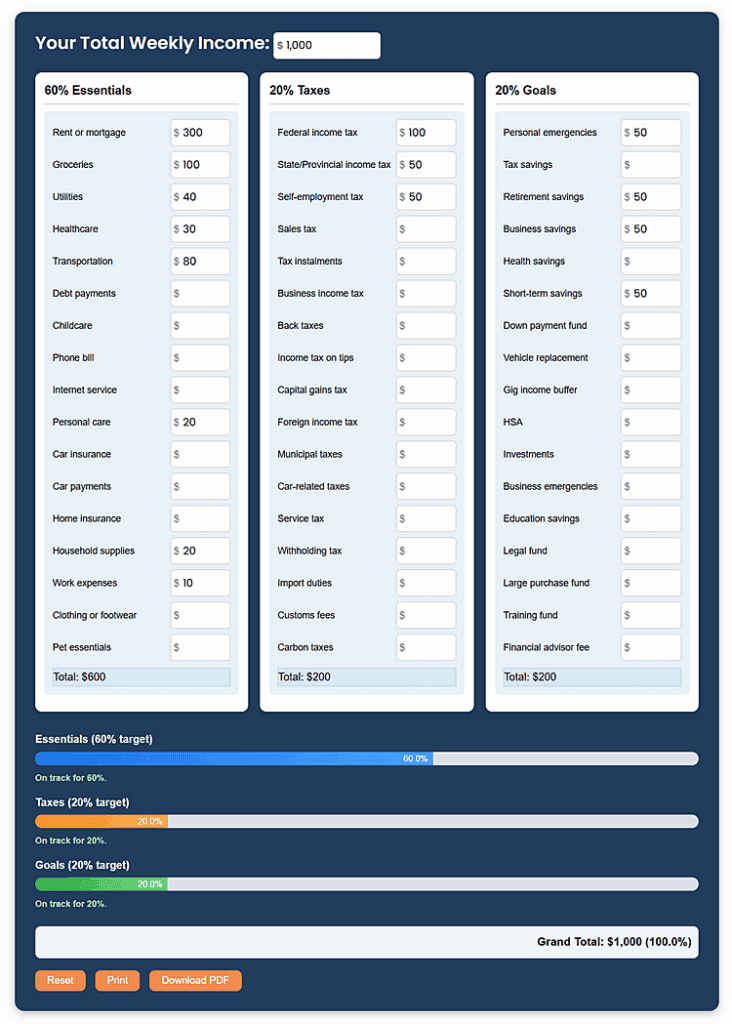
In this example, every dollar is assigned to a specific expense in each category on this online budget planner for gig workers, so you can see exactly how to stay on track.
Essentials: $600 (60%)
To meet your week-to-week needs without going over budget, you allocate:
- $300 to rent or mortgage
- $100 to groceries
- $40 to utilities
- $30 to healthcare
- $80 to transportation
- $20 to personal care
- $20 to household supplies
- $10 to work expenses
Column total: $600 (exactly 60% of $1,000 in weekly income)
Taxes: $200 (20%)
To fund your taxes ahead of time and avoid any year-end surprises, you set aside:
- $100 for federal income tax
- $50 for state/provincial tax
- $50 for self-employment tax
Column total: $200 (exactly 20% of $1,000 in weekly income)
Goals: $200 (20%)
To invest in your future, you save:
- $50 for emergencies
- $50 for retirement
- $50 for business savings
- $50 for short-term savings
Column total: $200 (exactly 20% of $1,000 in weekly income)
What This Online Budget Planner Shows
- All three progress bars hit their 60/20/20 targets perfectly.
- Each category is marked on track.
- The grand total equals $1,000 (100%), meaning every dollar has been allocated correctly.
- The planner highlights a clean, balanced weekly budget that follows the 60/20/20 rule without the need for any adjustments.
There’s an Easier Way to Budget Your Money
Budgeting on gig income doesn’t have to feel like guesswork or a math exam. Multiple apps out there can make managing unpredictable income much easier for you.
If you want something that works alongside this online budget planner for gig workers or automates part of the process, check out four of the best budget tools available on the market.
With Rocket Money, Simplifi, YNAB or Goodbudget, track spending, build a tax fund automatically and smooth out the ups and downs of gig income—without creating a full budget plan from scratch.
Rocket Money automatically analyzes your expenses, flags overspending, cancels unused subscriptions and helps you see where your money actually goes. It’s ideal if you need a clear direction before building a predictable budget.
Best for: Spending clarity + subscription cleanup
Pros
- Automatically tracks spending and categorizes expenses
- Cancels unused subscriptions for you
- Helps identify cash leaks quickly
- Clean UI that makes irregular-income tracking simple
Cons
- Some features require a paid plan
- Subscription negotiation can be hit-or-miss
- Not a full budget system (works best alongside the online budget planner)
Simplifi gives you a clear picture of your monthly and weekly cash flow, automatically categorizes transactions and helps you track “planned spending” buckets—great for unpredictable income streams.
Best for: Automated budgeting + cash-flow forecasting
Pros
- Automatically imports and categorizes transactions
- Excellent cash-flow forecasting based on real deposits
- Clean interface; easy to adjust categories
- Great for visual spend tracking
Cons
- Paid tool with no forever-free version
- Some bank connections can be slow
- Not as philosophy-driven as YNAB
YNAB (You Need A Budget) uses a “give every dollar a job” system that works surprisingly well for gig workers. If your income goes up and down like a rollercoaster, YNAB helps you prioritize essentials first, then goals, then everything else—without depending on fixed paychecks.
Best for: Hands-on budgeting for unpredictable income
Pros
- Excellent for gig workers with variable income
- “Give every dollar a job” works well with weekly budgeting
- Strong education and tutorials built in
- Encourages long-term financial habits
Cons
- Steeper learning curve
- Monthly subscription
- Too hands-on for people who want automation
Goodbudget uses digital “envelopes” to help you plan spending before you spend it. Gig workers like it because you can create envelopes based on real weekly income, not assumed monthly paychecks.
Best for: Envelope-style budgeting for irregular income
Pros
- Envelope system makes overspending harder
- Easy to use for couples or shared budgets
- Works well with variable income
- Simple, lightweight, not overly technical
Cons
- Manual tracking (no automatic bank sync on free plan)
- Less flexible than tools like YNAB
- Not ideal for people who want automation
Our Top Pick: YNAB
YNAB is the strongest overall choice for gig workers because it lets you budget weekly, stay aligned with the 60/20/20 method and stay on track, even when your income jumps all over the place.
YNAB is hands-on, flexible and ideal if you want a budgeting system that keeps you accountable without feeling too inflexible.
Runner-Up: Simplifi
Simplifi is a great alternative if you want something automated and visual. It pulls details from your transactions, forecasts your cash flow and helps you plan spending without micromanaging categories.
Simplifi is especially helpful if you prefer a budgeting tool that does most of the tracking work for you.
Take Control of Your Gig Life
Use this online budget planner for gig workers every week to build a budget that lets you cover your essentials, avoid tax-time panic and move closer to your financial goals.
Whether you earn $500, $1,000 or somewhere in between, this planner can help you stay financially organized and make smarter decisions with the income you actually have. Bookmark this page or print your results each week to stay on track.
Frequently Asked Questions (FAQs)
What does this online budget planner actually do?
It breaks your weekly income into Essentials, Taxes and Goals using the 60/20/20 method and does the math for you. As you enter your amounts, it totals each column, shows your 60/20/20 percentages, flags off-track spending and updates your grand total automatically, so you always know where your money is going.
Who is this budget planner designed for?
It’s for freelancers, gig workers, independent contractors and side-hustlers dealing with unpredictable income. Traditional budgeting apps expect neat, identical paychecks, which isn’t the reality the average gig worker faces. This planner gives you a realistic weekly breakdown that actually fits how gig life works.
Do I have to enter a perfect weekly income every time?
No, you can enter whatever you made this week or average your last four weeks for more realistic results. This online budget planner for gig workers adjusts to your actual or average weekly income instantly, even if your income is all over the place instead of a steady paycheck.
Does the budget planner enforce the 60/20/20 rule?
No, it doesn’t force anything. It simply shows how close (or far) you are from the 60/20/20 targets. If your Essentials creep higher or your Goals dip lower, this online budget planner for gig workers highlights these numbers, so you can decide what to fix instead of guessing.
Can I use the planner even if I don’t follow the 60/20/20 rule exactly?
Absolutely, you can use this online budget planner for gig workers. Most gig workers don’t hit 60/20/20 perfectly every week, and that’s normal. The planner gives you a clear snapshot of your spending and directs you to the best-possible budget plan for your situation.
What counts as an “essential” expense?
An “essential” expense is anything you need to live or work: rent, groceries, utilities, transportation, insurance, childcare, healthcare and minimum debt payments. If you can’t function without it or can’t work without it, it goes in Essentials.
What goes into the “taxes” bucket?
Federal, state/provincial and self-employment taxes, plus quarterly installments if you pay them. This section helps you stay ahead of tax season so you’re not scrambling when the bill comes due.
What goes into “financial goals”?
Savings, investments, debt payoff and anything that supports your future (or your future self not panicking). This includes emergency funds, retirement accounts, business savings, sinking funds and long-term plans.
Do I really need to set aside 20% for taxes?
It’s a smart starting point for most freelancers and gig workers. Your actual tax rate may be higher or lower depending on deductions and location, but 20% keeps you out of trouble and away from nasty surprises.
Can I use this budget planner instead of a budgeting app?
Yes, it’s simple, fast, free and built specifically for irregular income. You can still pair it with apps like YNAB, Simplifi or Goodbudget if you want automated transfers or spending tracking behind the scenes.
Photo by Vitaly Gariev on Unsplash