


Updated on December 8, 2025
Written by The Wealthy Gigster Team
Edited by Kevin Nishmas, Managing Editor
At a Glance
Gig jobs that pay weekly are the closest thing to steady income most gig workers will ever see. Faster payouts make everything a little more manageable, getting money into your account when you actually need it. They help you dodge slow-paying gig apps, stay ahead of your rent and groceries, and stop that weekly spiral of wondering why your earnings evaporate the minute you get them. Of course, gig jobs that pay weekly won’t fix everything, but they give you breathing room when your bills refuse to wait.
Table of Contents
- Key Takeaways
- What to Expect From Gig Jobs That Pay Weekly
- Why Gig Workers Need Gig Jobs That Pay Weekly
- Top Gig Jobs That Pay Weekly
- How to Choose the Right Gig Jobs That Pay Weekly
- How Weekly Gigs Actually Pay Off in Real Life
- How to Get More Out of Gig Jobs That Pay Weekly
- Live a Richer Gig Life
- Frequently Asked Questions (FAQs)
Key Takeaways
- Weekly payouts reduce financial anxiety, especially when invoices go MIA.
- Not all gig jobs that pay weekly pay you the same amount every week.
- Weekly pay smooths out unstable cash flow.
- Some weekly gigs give you daily cash-out options.
- Weekly pay helps avoid relying on credit cards during slow weeks.
What to Expect From Gig Jobs That Pay Weekly
Gig workers don’t need a TED Talk lecture on unstable income. They have a front-row seat to feast-or-famine paychecks 24/7. If you’re a gig worker, you know the drill: one week you take home a solid paycheck, the next your clients ghost you. Meanwhile, bills, groceries and rent keep piling up, whether your income does or not.
Gig jobs that pay weekly can change all that. According to recent Visa Business and Economic Insights research, gig workers who get paid faster lean less on credit cards and feel less financial whiplash. Still, a weekly payout isn’t a miracle cure but it could mean more money in your pocket when you need it.
Discover six gig jobs that pay weekly, what each gig actually offers and how to choose the right ones. Plus, learn how to stack weekly gigs for steadier income and sidestep the ones that pay fast but earn slow.
Why Gig Workers Need Gig Jobs That Pay Weekly
Weekly payments aren’t a luxury for gig workers. They’re fuel for survival. When your gig income swings from “phew, my rent is paid” to “my bank account emptier than a ghost town,” gig jobs that pay weekly give you just enough stability to breathe, and maybe save a few bucks.
When you live on irregular income, waiting two or three weeks for money feels like a punishment for choosing freedom over practicality. With gig jobs that pay weekly, you get paid often enough to handle these out-of-pocket costs:
- Gas
- Groceries
- Surprise bills
- Last-minute kid expenses
- Quarterly taxes
- Emergency car repairs
Weekly payouts provide breathing room. They make irregular income feel slightly less like a roller coaster operated by a sadist-in-training. Weekly payout gigs also reduce credit card dependence.
Without weekly income, it’s too easy to swipe your way into debt during slow spells. With gig jobs that pay weekly, your next injection of cash is never far away.
Why You Can Trust The Wealthy Gigster
We don’t do fluff. And we definitely don’t let advertisers tell us what to say. Every product or service we recommend is vetted using real data, independent research and the financial chaos test: “Would this product or service actually help someone with an irregular income and a rent deadline?”
We rate tools and services based on what matters to gig workers, not 9-to-5ers. If we earn a commission from a partner, you’ll know—but our opinions stay brutally honest, no matter what.
Want the receipts? Check out our About Us, Editorial Standards and Advertising Disclosure pages for how we work and what makes our recommendations worth your time (and money).
Top Gig Jobs That Pay Weekly
Weekly pay doesn’t automatically mean weekly income. Some gig apps limit orders, drown your area with new workers or make you wait days just to get approved.
If you want reliable weekly cash, the gig jobs that pay weekly have to be easy to start, simple to fit into your schedule and steady enough that you don’t spend half your week refreshing the app.
Below are the top six gig jobs that pay weekly and don’t require jargon-filled onboarding or a 30-minute personality test.
1. Uber & Lyft (Weekly Payouts + Instant Cashouts)
What Uber & Lyft do
Uber and Lyft connect riders with drivers who use their own cars to complete trips. You decide when you drive, how much you drive and whether you’re mentally stable enough to weather rush hour.
What Uber & Lyft offer
Weekly direct deposits are standard, but most drivers use Instant Cashout, a same-day payout for a small fee. Consider it the cost of not having your debit card rejected in public again. Earnings vary, but most drivers average $18–$28/hour depending on demand and location.
Why this weekly gigs work
Peak hours, surge pricing and airport runs can stack fast. If you work in a busy neighborhood and don’t mind talking to strangers (or pretending to), Uber or Lyft can be one of the most reliable weekly-income gigs.
2. Instacart (Weekly Payouts + Instant Cashouts)
What Instacart does
Instacart connects shoppers with customers who need groceries delivered from local stores. You pick batches, shop the order and deliver it to earn per-order pay + tips.
What Instacart offers
Instacart pays weekly by default, plus same-day cashouts for a small fee. If you live near a busy grocery store, you can combine:
- Tips
- Heavy-order bonuses
- Peak-hour pay
- Batch stacking
Earnings vary, but most shoppers average $18–$25/hour depending on the city.
Why this weekly gig works
You can jump in whenever you need fast cash. In other words, no schedule commitment.
3. Shipt (Weekly Payments + Reliable Tips)
What Shipt does
Shipt is a membership-based grocery delivery service where shoppers pick up orders from partnered stores like Target and deliver them to customers. You earn through order pay, tips and promo bonuses.
What Shipt offers
Shipt’s weekly payouts are consistent and some markets tip better than Instacart. If you live near Target, Meijer or Publix, this gig is gold. Earnings vary, but most Shipt shoppers make $16–$24/hour. In tip-heavy neighborhoods, you can earn even more money.
Why this weekly gig works
This gig works best in suburbs where wealthy families place the same grocery order every week like clockwork. You’ll also like the human interaction that comes with the job (or hate it). Either way, money lands into your pocket weekly.
4. DoorDash (Weekly Pay That Never Sleeps)
What DoorDash does
DoorDash lets gig workers deliver food, groceries and convenience items from restaurants and stores in their area. You earn per delivery, plus tips, peak pay and weekly or instant payouts.
What DoorDash offers
DoorDash is one of the most dependable gig jobs that pay weekly. Dashers get:
- Weekly direct deposits
- FastPay (instant cashouts)
- Peak pay bonuses
- Weekly challenges that boost your pay
Earnings vary, but most DoorDash drivers make $15–$25/hour. Usually, late-night customers tip better than the daylight desk jockeys pretending they don’t see you.
Why this weekly gig works
DoorDash wins for flexibility. You can dash at 11:00 am, 3:00 pm, midnight or somewhere in between.
5. Rover (Weekly Payouts for Pet Gigs)
What Rover does
Rover pairs pet owners with sitters and walkers who can handle everything from quick walks to full-on dog sleepovers. You set your rates, pick your clients and only say yes to the animals you actually like.
What Rover offers
If you like dogs more than humans (a fair preference), Rover pays weekly for:
- Walks
- Sitting
- Boarding
- Drop-ins
Earnings vary, but most Rover sitters earn $18–$30/hour, especially once repeat clients start treating you like their dog’s full-time emotional support human.
Why this weekly gig works
Gig workers love Rover because clients often rebook the same sitter repeatedly, creating stable weekly income you can depend on.
6. TaskRabbit (Weekly Pay for Random Skills)
What TaskRabbit does
TaskRabbit connects people who need random household help with gig workers who can actually get things done. You choose the tasks you want, set your rates and skip anything that looks like a future lawsuit.
What TaskRabbit offers
TaskRabbit has weekly payouts and higher hourly earning potential than most delivery apps. It’s great for people who can:
- Assemble furniture
- Fix small home issues
- Help people move
- Mount TVs
- Declutter garages
Earnings vary, but most TaskRabbit workers make $20–$45/hour, mostly for the harder jobs people swear they’ll “get to eventually.
Why this weekly gig works
You can earn weekly by taking on assembly, moving, repair or general “make this problem disappear” jobs. You control your schedule, your pricing and how much chaos you’re willing to walk into.
How to Choose the Right Gig Jobs That Pay Weekly
Payouts every seven days help, but they don’t fix a bad gig. The trick is choosing a gig job that’s also a good fit for you. A gig can pay weekly, but if you’re exhausted, underpaid or stuck in a dead zone with no orders, you’ll still end up broke every week.
Here’s how to avoid wasting time on the wrong weekly gig and choose one that earns you consistent, predictable cash every week.
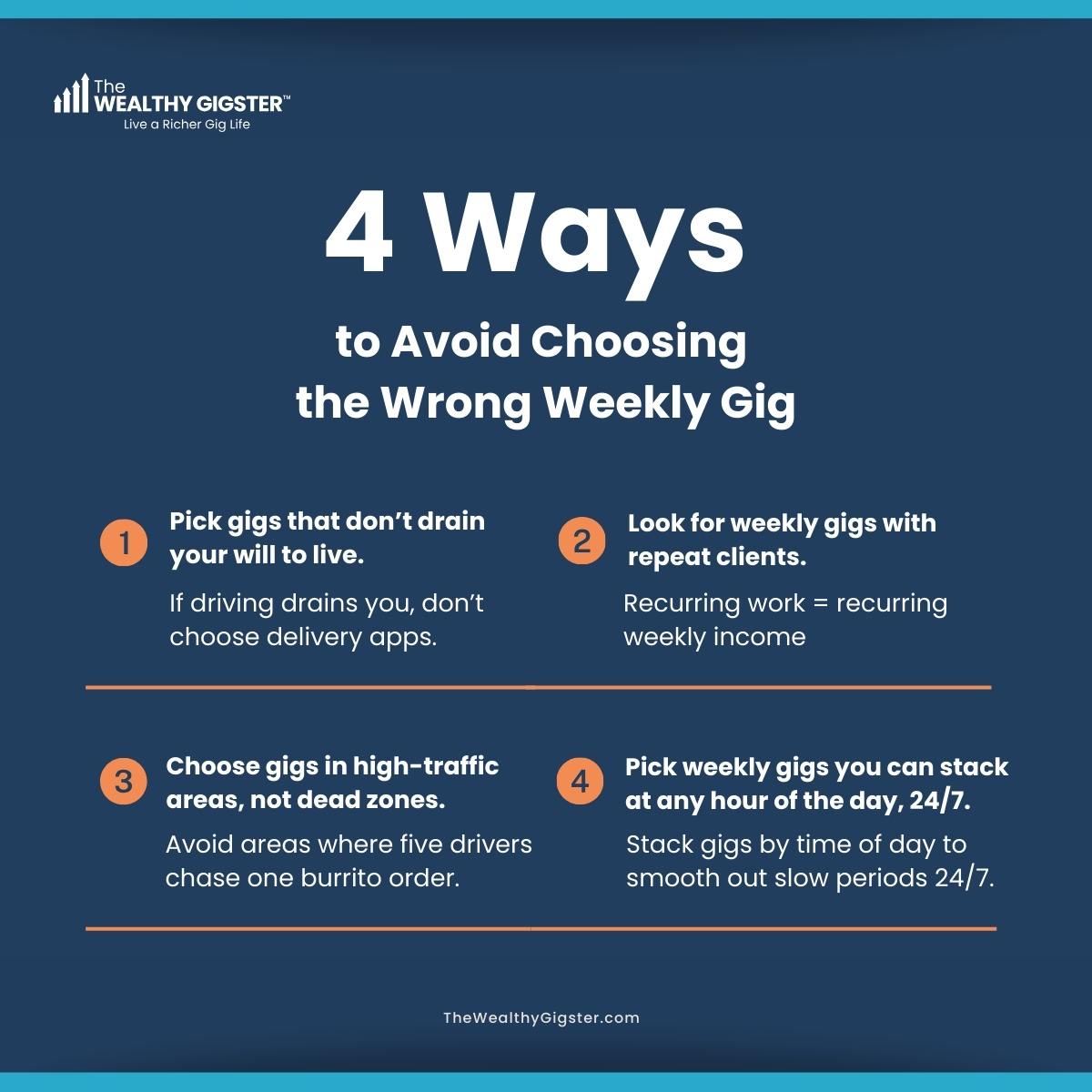
Pick gigs that don’t drain your will to live
Your energy is currency. If a gig drains you, good luck making money off fumes.
Delivery apps make earning money look simple, but if driving stresses you out, you’ll burn out in a week. If human interaction makes you question society, avoid grocery shopping or task gigs that require chatting. On the flip side, if walking dogs sounds like therapy disguised as income, Rover’s a safe bet.
A simple rule of thumb: If you hate the work, you won’t do enough of it to earn weekly. If the work energizes you, you’ll earn more without even noticing.
Your energy determines your stamina, and your stamina determines your weekly earnings.
Choose gigs in high-traffic neighborhoods, not dead zones
A weekly payout only helps if you actually have work to get paid for. Demand decides everything: more orders, more clients, more payouts. If you live in a neighborhood where tumbleweeds outnumber humans, no weekly-paying gig job can save you.
Weekly gigs work best in places like:
- College towns where students never cook and always need everything delivered yesterday
- Suburbs with high household incomes where people outsource errands without blinking
- Highly populated cities where delivery demand is 24/7 and every block has 10 potential customers
But avoid the areas where five drivers chase one burrito order like it’s the last meal on earth. Saturation kills earnings, even with weekly payouts. Weekly pay is only helpful when paired with weekly opportunity.
Pick weekly gigs you can stack (or watch your income flatline)
Every gig has slow hours. Smart gig workers patch those gaps with other weekly-paying gigs. This isn’t “hustle harder” advice. It’s “stop sitting around waiting for a gig to send you something” advice.
The most stable earners stack gigs by time of day:
- DoorDash for lunch and dinner hours
- Instacart for afternoon shopping rushes
- TaskRabbit for weekend jobs or high-paying one-offs
Instead of one gig app deciding your income, you build a predictable rotation of jobs that smooth out slow periods and keep your money coming in. This is how you turn gig life volatility into a weekly paycheck.
Look for weekly gigs with repeat clients (unpredictability is overrated)
Nothing beats weekly work from people who keep coming back for more. Gig apps like Rover and TaskRabbit aren’t just “random gigs” for you. They’re pipelines for repeat customers who want the same sitter, walker or tasker every time.
Repeat clients give you:
- Predictable weekly earnings
- Better tips from greater trust
- Less onboarding time per job
- Steady income without constantly refreshing apps
- Bookings you can plan around
If you want weekly paychecks, work with clients who act like weekly money. Delivery apps can spike and crash, but repeat orders? That’s actual stability.
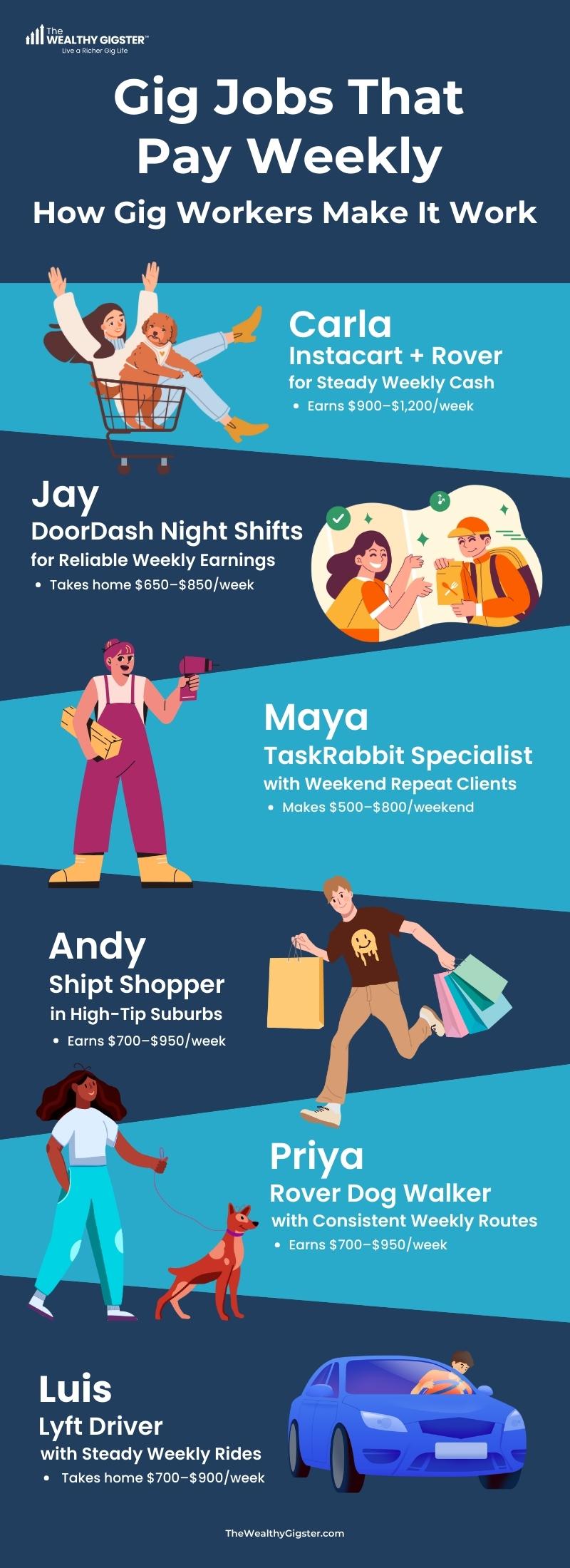
How Weekly Gigs Actually Pay Off in Real Life
How to Get More Out of Gig Jobs That Pay Weekly
Weekly gigs put money in your account. These tools help you keep it there. Mileage tracking, expense tools and bill-cutters plug all the leaks in your wallet, so your weekly payouts don’t vanish into gas, taxes or surprise charges.
Why we like it: Tracks mileage automatically, so gig workers can take bigger tax deductions and keep more of their earnings.
Best for: Rideshare and delivery drivers who put lots of miles on their car.
Pros
- Free mileage tracking
- Generates tax-ready reports
- Easy-to-use app
Cons
- Lacks advanced reporting and customization
Why we like it: Handles expense tracking and mileage logging automatically, which helps gig workers stay organized without extra effort.
Best for: People juggling multiple gigs or variable income.
Pros
- Auto-classifies trips and expenses
- Strong tax tools
- Easy to use on mobile
Cons
- Full automation requires a paid plan
Why we like it: Cuts wasteful spending by canceling unused subscriptions and negotiating lower bills.
Best for: Gig workers with income that changes from week to week.
Pros
- Finds and flags unused subscriptions
- Negotiates bills
- Clear spending insights
Cons
- Savings fee applies to certain bill-reduction features
Our Top Pick: Stride
Stride comes out on top because it delivers the biggest financial impact for gig workers with the least headaches. It’s completely free, handles mileage tracking automatically and helps you capture the largest tax deduction most gig workers have.
Since mileage directly affects how much of your weekly income you actually keep, Stride quietly saves you more money over a year than any other tool in this list. It’s simple, accurate and protects earnings every time you get in your car.
Runner-Up: Rocket Money
Rocket Money takes second place because it handles the money leaks most gig workers never get around to plugging, like unused subscriptions, overpriced bills and unnecessary charges that slowly eat into your weekly payouts.
When your income fluctuates, keeping expenses under control matters just as much as bringing money in, and Rocket Money does that reliably. The only reason it isn’t the top pick is the small savings fee on certain features, which gives Stride an edge as the universally cost-effective choice.
Live a Richer Gig Life
The right weekly gigs can protect your mental health and your bank account. With gig jobs that pay weekly, you’re not waiting for companies to “process” your money like it’s radioactive. You get fast, predictable income you can use right now.
And now for the lecture you knew was coming. If your payouts can’t keep up with your bills, that’s your cue to start stacking gigs that pay weekly—and on time.
Frequently Asked Questions (FAQs)
What are the most reliable gig jobs that pay weekly?
The most reliable gig jobs that pay weekly are Uber, Lyft, Instacart, Shipt, DoorDash, Rover and TaskRabbit. These platforms offer predictable weekly deposits and, in many cases, optional same-day cashouts. Reliability comes down to demand in your neighborhood, tipping patterns and whether the gig fits your actual energy level.
Do all gig jobs that pay weekly earn the same amount every week?
No, weekly pay only guarantees when you get paid, not how much. Order volume, market saturation, time of day and location all affect your earnings. Many gig jobs that pay weekly also have bonuses and repeat-client potential that can boost your income, but the amount you earn can still go up one week and tank the next.
Which gig jobs that pay weekly are best for beginners?
Beginners often do well with DoorDash, Instacart, and Rover because onboarding is quick and earnings start flowing in immediately. DoorDash offers flexible hours, Instacart works for people who like shopping without all the talking, and Rover is ideal if you’d rather deal with dogs than humans. All offer weekly payouts and the chance to build consistent income.
How do I pick the right weekly gig if my income is unpredictable?
Choose gig jobs that pay weekly based on three things. The first is your energy. If driving stresses you out, don’t pick delivery apps. If dogs calm your soul, go Rover. The second is your location. High-traffic neighborhoods equal more orders, which means more weekly cash for you. The third thing is stackability. The savviest gig workers combine DoorDash, Instacart and TaskRabbit to cover slow hours. Ultimately, though, your earnings depend as much on the right fit as on the right gig.
How can I keep more of the money from gig jobs that pay weekly?
Use tools that reduce expenses and track deductions. Mileage apps like Stride and Everlance help you save at tax time. Rocket Money cuts unnecessary subscriptions and negotiates bills. These tools won’t make you money, but they’ll stop it from leaking out of your account, which is basically the same thing when it comes to gig-worker math.
Get free gig money advice.
Because you earned it.
Sign up for our newsletter and get the free gig money advice you need to live a richer gig life.
By subscribing to our newsletter, you acknowledge and agree to our Terms of Use and Privacy Policy. You can unsubscribe at any time.
Photo by Gift Habeshaw on Unsplash