

Updated on September 2, 2026
Written by The Wealthy Gigster Team
Edited by Kevin Nishmas, Managing Editor
At a Glance
The 60/20/20 budget for irregular income gives you a simple, adaptable budgeting approach to follow: 60% of your income goes to essentials, 20% to taxes and 20% to your financial goals. Unlike traditional monthly budgets, this one works weekly, making it ideal for freelancers, independent contractors, solopreneurs and other self-employed workers who live with irregular income—because it can be adjusted week by week. Because the percentages can be recalculated whenever money comes in, the system can flex with uneven earnings while helping you cover essentials, prepare for taxes and keep making progress toward your financial goals.
Table of Contents
- Key Takeaways
- Why Does Irregular Income Need a 60/20/20 Budgeting Strategy?
- What Is the 60/20/20 Rule—And How Is It Different?
- Should You Budget Weekly When Your Income Is Irregular?
- What Belongs in Your 60% “Essentials” Bucket?
- Why Should You Always Carve Out 20% for Taxes?
- How Should You Use the Final 20% to Build the Future You Want?
- Download Your Free 60/20/20 Budget Worksheet Template
- How Do You Automate Your 60/20/20 Budget?
- How Do You Handle Budget Blowups Without Ditching the 60/20/20 Rule?
- What If Your Income Is Too Low for The 60/20/20 Budget Strategy?
- What is the Best Time to Review and Adjust Your 60/20/20 Budget?
- What Are Common 60/20/20 Budget Mistakes With Irregular Income?
- Final Thoughts
- Frequently Asked Questions (FAQs)
Key Takeaways
- The 60/20/20 budget for irregular income divides the income you receive into three easy buckets (60% essentials, 20% taxes, 20% financial goals).
- This strategy works for freelancers, independent contractors, solopreneurs and independent earners, not just app-based earners.
- This weekly budgeting approach is ideal for people with irregular income (since you can just recalculate your 60/20/20 percentages based on what you made that week).
- The 60/20/20 Budget Worksheet Template helps you see exactly where your money should go (and where you might be overspending) on a week-by-week basis.
- Taxes are non-negotiable (budget for them like your financial well-being depends on it, because it does).
- The final 20% is where you build the life you actually want (it’s how you go from just getting by to finally getting ahead).
Why Does Irregular Income Need the 60/20/20 Budget Rule?
Traditional budgets weren’t built for life with irregular income. They assume you receive a predictable paycheck, work the same hours each week and rely on built-in benefits like health insurance and a retirement plan. If you’re like many irregular income earners, you have none of that predictability built into your financial life.
When your income swings every which way like a busted screen door in the wind, trying to fit your finances into a rigid, one-size-fits-all monthly budget is like squeezing into jeans from your teenage years. It’s uncomfortable and unsustainable.
Without a budget that adapts to the week-in, week-out changes in your freelance income, you end up in survival mode. Constantly reacting. Dreading slow weeks. Burning through savings (if you have any left).
Enter the 60/20/20 budget rule: a flexible, adaptable budgeting system that adjusts to the unpredictable ups and downs of irregular income weekly—and puts you back in control.
Why You Can Trust The Wealthy Gigster
We don’t do fluff. And we definitely don’t let advertisers tell us what to say. Every product or service we recommend is vetted using real data, independent research and the financial chaos test: “Would this product or service actually help someone with an irregular income and a rent deadline?”
We rate tools and services based on what matters to people managing irregular income, not just people with predictable paychecks. If we earn a commission from a partner, you’ll know—but our opinions stay brutally honest, no matter what.
Want the receipts? Check out our About Us, Editorial Standards and Advertising Disclosure pages for how we work and what makes our recommendations worth your time (and money).
What Is the 60/20/20 Budget Rule—And How Is It Different?
The 60/20/20 budget for irregular income is a percentage-based plan that adapts to what you actually earn—not the other way around.
The 60/20/20 rule splits the income you receive into three clear percentages:
- 60% for essentials: rent, food, gas, utilities and work gear
- 20% for taxes: income tax, self-employment tax and state taxes
- 20% for financial goals: savings, retirement and investments
Instead of itemizing every last coffee, you zoom out. You get a bird’s-eye view of where your money should be going or where you’re overspending—and you track your cash flow in broad strokes.
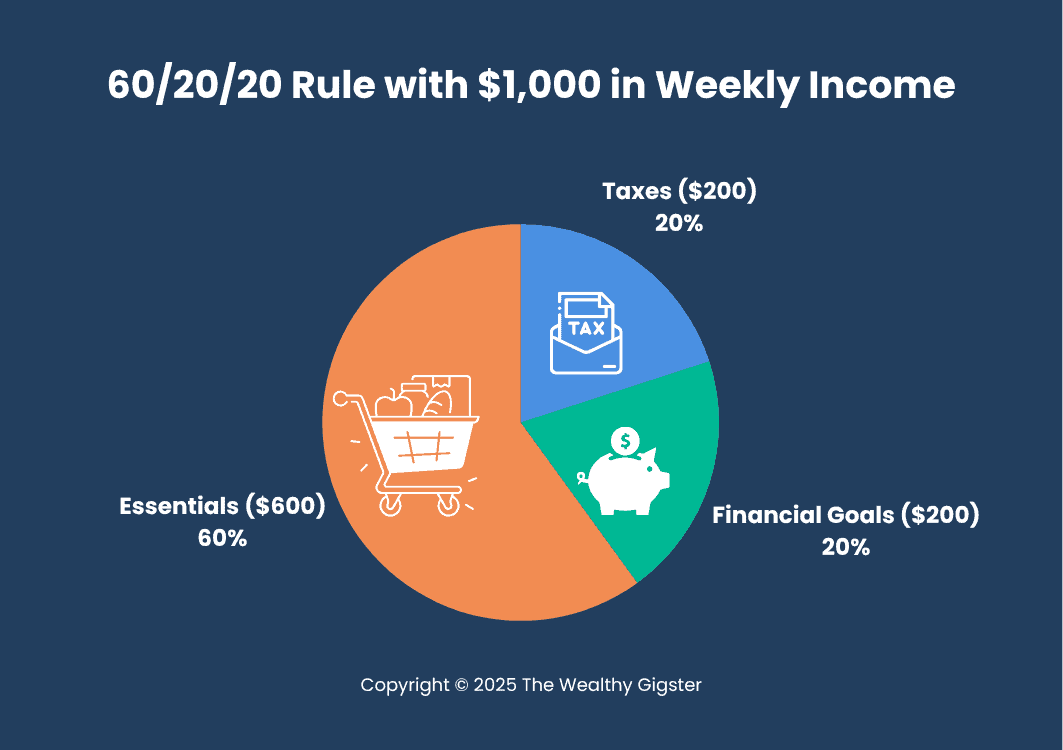
Real-World Math: The 60/20/20 Budget for Irregular Income in Action
If you make $1,000 this week:
Should You Budget Weekly When Your Income Is Irregular?
Yes. Weekly budgeting can make irregular cash flow much easier to manage because you can adjust your spending and savings as income arrives. It’s also a solid budget approach for freelancers, digital nomads and independent creators juggling multiple clients or earning platforms.
Waiting until month-end to figure out if you’ve made enough income is a recipe for anxiety. Budgeting by week keeps you agile. It lets you adapt your budget in real time. There’s no guesswork, no last-minute panic.
Freelancers and other independent earners often receive money from multiple clients, contracts, platforms or income streams. A weekly structure lets you rebalance your cash flow regularly, instead of relying on guesstimates.
Real-World Math: Budgeting on Fluctuating Weekly Income
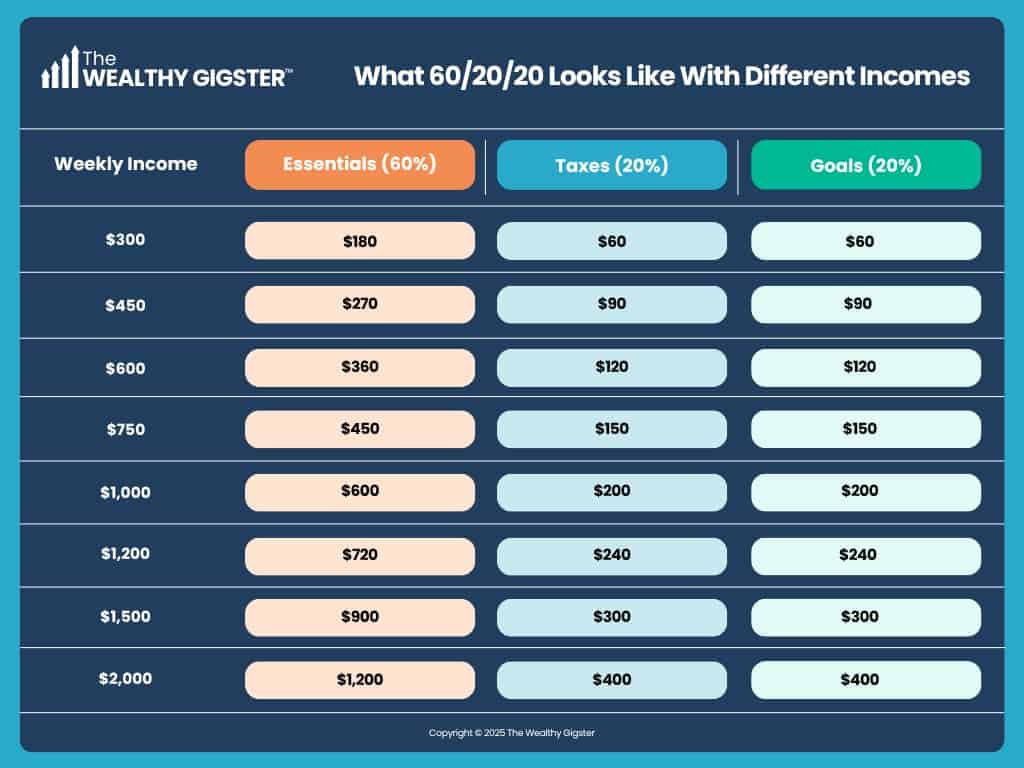
Because the 60/20/20 budget for irregular income is percentage-based, it flexes with your income. No matter how much you earn, you always know how to split it—and avoid that dreaded “Oops, I overspent” spiral.
Let’s say your income fluctuates week to week:
Week 1: You earn $450
- 60% ($270) → Essentials (rent, food, transportation)
- 20% ($90) → Taxes (self-employment, state, federal)
- 20% ($90) → Financial goals (debt repayment, savings, investing)
Week 2: You earn $950
- 60% ($570) → Essentials (maybe extra groceries, a utility bill)
- 20% ($190) → Taxes (more income = more money set aside for taxes)
- 20% ($190) → Financial goals (bigger payment toward credit cards or emergency fund)
What Belongs in Your 60% “Essentials” Bucket?
Your essentials category should include your bare-minimum expenses to live and work. Think rent, food, health care and everything else you can’t ghost without consequences.
“Essentials” include your housing, food, transportation, phone, insurance, childcare and utilities. For freelancers, self-employed workers, independent contractors and other independent earners, essentials can also include work tools that keep you earning, like software, data and equipment.
This is not the time to fudge the numbers. Essentials = what keeps you employed, sheltered and alive. It’s different for everyone, but it’s got to be an honest calculation.
Real-World Math: Weekly “Essentials” Breakdown
Let’s say your weekly income is $1,200. Using the 60/20/20 rule, here’s how you should split your earnings for the week:
- 60% = $720 for essentials
- 20% = $240 for taxes
- 20% = $240 for financial goals
Now let’s break down the essentials category:
- Rent: $400/week (if paid weekly)
- Groceries: $100/week
- Phone bill: $50/week
- Gas: $70/week
- Car insurance: $50/week
Total spent on essentials: $670
That leaves you with $50 left in your essentials bucket. You can:
- Use it as a buffer for surprise expenses (like an oil change)
- Pay a small bill (such as a subscription or minimum credit card payment)
- Roll it into next week if you know a bigger cost is coming
The beauty of this system? You always know what’s safe to spend—and what’s already spoken for.
Why Should You Always Carve Out 20% for Taxes?
One of the easiest traps with irregular income is spending money that will eventually be needed for taxes. Setting aside part of every payment as soon as it arrives can make tax season far less painful. The 20% tax bucket in this framework is a simple starting point, but your actual tax obligation may be higher or lower depending on your income, location, deductions and tax situation.
If you don’t plan for taxes, they’ll ambush you like a surprise bill at tax time. If taxes aren’t withheld from your payments, you have to plan for them yourself. That means you’ve got to be your own accountant. You need to figure out how much to have in your bank account to pay your taxes on time.
The 20% tax bucket gives you a dedicated reserve for taxes instead of leaving the full amount sitting in your spending account. It’s your built-in reminder to keep the tax man off your back and out of your savings because, let’s face it, the government never forgets, even when you do.
For freelancers, independent contractors and self-employed workers, planning ahead for taxes is essential. A 2025 survey from Avalara found that 74% of independent earners can’t identify the IRS 1099‑K income threshold, and many end up scrambling at year‑end to figure out what they owe.
When you carve out that 20% weekly, you shield yourself from penalties, stress and having your bank account hit hard around tax time.
Real-World Math: 20% “Tax” Bucket
Let’s say you earn $800 this week. Using the 60/20/20 budget for irregular income, $160 (20% of $800) should go straight to your tax bucket. For budgeting purposes, you could simply move that $160 into a separate tax account immediately:
- Move the full $160 to your dedicated tax account
- Treat 20% as a budgeting starting point, not a guaranteed tax rate
- Adjust the percentage if your expected tax bill is higher or lower
By setting aside $160 immediately:
- You won’t be caught off guard when the IRS asks for their cut
- You avoid draining your emergency fund to cover taxes
- You may even end up with extra left over (for a small splurge)
Even better, move that $160 to a high-yield savings account labeled “Do Not Touch (Tax Money).” Automate the transfer if you can. You’ll thank yourself during tax season when everyone else is stressing out.
How Should You Use the Final 20% to Build the Future You Want?
For solopreneurs, freelancers and digital nomads, the final 20% bucket for financial goals is your freedom fund. Don’t waste it. The last 20% of the 60/20/20 budget for irregular income is reserved for financial goals rather than everyday spending. It’s for building your future, your way. That means paying down debt, investing in IRAs, creating an emergency fund or saving for a down payment.
This 20% gives you breathing room. It gradually turns your feast-or-famine income into financial stability and control. Some weeks you’ll only save $40. Others, $400. That’s fine—as long as you consistently set aside 20% for your most important financial goals every week.
The Everee 2025 Gig Driver Report looked into financial coping strategies among 419 U.S. gig drivers (Uber, DoorDash, Shipt). The key takeaways:
- 59% relied on gig work for at least half their income
- 65% had taken payday loans due to delayed gig earnings
- 61% postponed essential purchases when pay was slow
Translation: When your income is unpredictable, you’re essentially walking a financial tightrope—without a safety net. Budgeting methods like the 60/20/20 budget rule transform those highs and lows into predictable, manageable amounts.
Real-World Math: 20% “Financial Goals” Bucket
Let’s say you earn $1,000 this week. With the 60/20/20 budget for irregular income, the final 20%—aka your “financial goals” bucket—is $200 for building your future (not just surviving today). Here’s how you might break it down:
- $100 to your emergency fund – For when your car dies, a client payment is late or life throws something stupid at you. Every deposit brings you closer to sleeping soundly through the next crisis.
- $50 to your investment account – Could be a micro-investing app like SoFi or Acorns. The point? Start now—even small amounts grow if you keep showing up weekly.
- $50 toward credit card debt – Not glamorous, but important. Tackling it little by little helps reduce interest and keeps you from sinking when your irregular income dips again.
This is how that final 20% can take you from paycheck-to-paycheck to actually making financial progress. Even when you’re not earning big, you’re still moving forward to the future you want to live.
Download Your Free 60/20/20 Budget Worksheet Template
Budgeting advice means nothing if you don’t know where your money is going. Using a 60/20/20 budget worksheet can help you track your income and spending, stay accountable and make smarter decisions week by week.
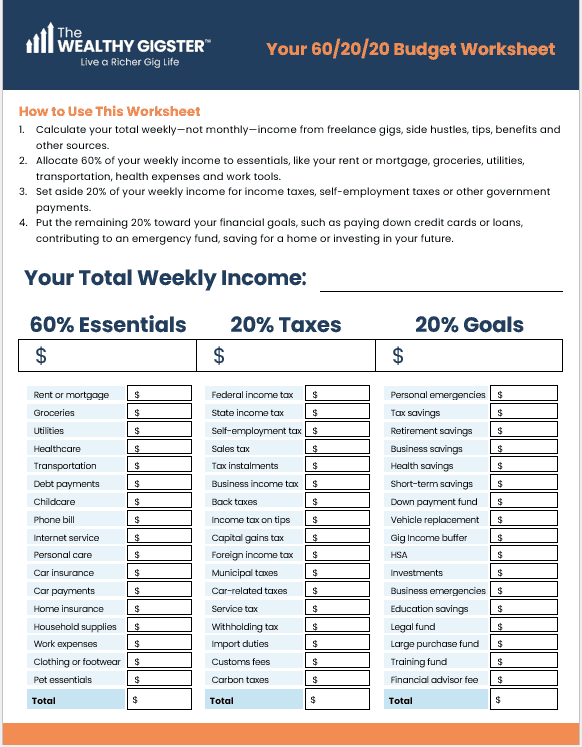
To get started, download our free 60/20/20 Budget Worksheet for Irregular Income, a no-nonsense, easy-to-use tool designed to help you apply the 60/20/20 rule week by week—with line-by-line suggestions for what counts in each category.
How to Use the 60/20/20 Budget Worksheet
Start by entering your total weekly income from all your clients, contracts, side hustles, tips and other income sources. Next, allocate that amount to three categories:
- 60% for essentials (like groceries, rent, phone bill, gas)
- 20% for taxes (such as federal tax, state tax, self-employment tax and sales tax)
- 20% for financial goals (like debt repayment, savings or investing in future-you)
Each category comes with a detailed list of example expenses—so you’re never left wondering what “essentials” or “goals” actually mean in your life. It gives you room to track what you earn, how you spend and where to pivot—one week at a time.
Want to finally see where your money should go (and where it’s slipping through the cracks)? Here’s a preview of a downloadable worksheet that can keep your weekly budget real—and you in control.
Click here to download your free worksheet and start budgeting weekly.
The 60/20/20 worksheet is a solid starting point—especially if you’re a pen-and-paper type or just learning how to budget weekly. But once you get the hang of things, it’s worth leveling up to budgeting tools that do the heavy lifting for you.
Want to see exactly how to split your weekly income using the 60/20/20 budget for irregular income? Try our free 60/20/20 Budget Calculator to automatically (and instantly) find out how much to set aside for essentials, taxes and savings—no spreadsheets and no stress necessary.
How Do You Automate Your 60/20/20 Budget?
Set up automatic transfers: 60% to checking for bills, 20% to a separate tax account and 20% to a savings or investment account. Most online banks or apps make this easy. Set it once. Forget it. Let your budget run in the background while you do literally anything else.
The less you have to think about moving money, the more consistent you’ll be with your 60/20/20 budget. Even better, apps and automation tools can save you time and help you track, tweak and stay on top of your money with way less effort.
Whether you’re trying to keep taxes in check, hit savings goals or finally make your budgeting stick, these irregular-income-friendly tools can do the heavy lifting while you focus on earning.
Best Budgeting Apps for Irregular Income: Manual + Weekly-Friendly
If you’re juggling multiple income streams and irregular payments, you need a budgeting app that’s built for your reality—not your accountant’s. These apps make it easier to track your weekly income, separate your essentials from your wants and stick to the 60/20/20 budget for irregular income without breaking into a spreadsheet-induced panic.
Best for: Hands-on budgeters who want total control over weekly income and goals
Why We Like It: It’s built around giving every dollar a job—perfect for applying the 60/20/20 rule on a weekly basis.
Tool Details: Works across devices, syncs accounts and focuses on aging your money and forecasting expenses.
Best for: Couples or solo users who want sleek visuals and detailed tracking
Why We Like It: Its dashboard gives a clean, instant snapshot of spending, making it easy to compare income vs. goals.
Tool Details: Provides bank syncing, customizable dashboards and long-term planning tools.
Best for: Tracking real-time cash flow and spending trends
Why We Like It: It’s easy to see where your money is going, and it adapts well to weekly or fluctuating incomes.
Tool Details: Automatically categorizes income and expenses, tracks cash flow in real time and offers forecasting.
Best for: Quick-glance spenders who need a “safe to spend” number
Why We Like It: It strips budgeting down to the basics and keeps you from blowing through your essentials.
Tool Details: Connects to accounts, analyzes bills and spending, and recommends budget tweaks.
Best for: Freelancers, independent earners and the self-employed who need accountability and don’t mind some sass
Why We Like It: It uses AI (and humor) to make budgeting more engaging and surprisingly helpful.
Tool Details: Includes a budgeting assistant via chat, sends spending alerts, tracks trends and savings goals.
Best for: Fans of zero-based budgeting who are disciplined weekly planners
Why We Like It: It’s a solid app if you’re ready to plan every dollar manually—just not as flexible as others.
Tool Details: Requires hands-on setup and tracking (based on Dave Ramsey’s zero-based budgeting method).
Our Top Pick: YNAB (You Need A Budget)
If you want a budgeting app that helps you plan weekly, stick to the 60/20/20 rule and actually stay consistent, YNAB is your best bet. It’s hands-on, flexible and built for people with irregular income who want to take control.
Runner-Up: Monarch Money
For a more visual, intuitive experience—especially if you’re budgeting with a partner—Monarch Money is a sleek alternative that still gets the job done without overwhelming you with too much detail.
Best Tools for Automating Savings + Transfers: Set It and Forget It
These tools help you move your money automatically—so the 20% buckets for your financial goals and taxes fill up without needing manual transfers, reminders or willpower. Each one is tailored to make sticking to your 60/20/20 budget smarter and easier.
Best for: Rule-based automation with total customization
Why We Like It: It lets you set creative savings rules that align perfectly with weekly income habits.
Tool Details: Creates savings triggers based on spending, round-ups, goals or even specific days of the week.
Best for: Freelancers who need hands-off savings for taxes and benefits
Why We Like It: It’s built specifically for independent earners, and makes saving for taxes feel painless.
Tool Details: Automatically withholds a certain percentage from each deposit for taxes, retirement and even paid time off.
Best for: Simple auto-savers who want to earn interest too
Why We Like It: It offers basic automation and competitive interest rates—great for beginner savers.
Tool Details: Sets up recurring weekly transfers and rounds up savings from purchases into a high-yield savings account.
Best for: Remote workers who want smart savings and financial guidance
Why We Like It: It uses automation and real human advice to help you save, invest and improve your finances without lifting a finger.
Tool Details: Offers auto-savings based on your income and spending habits, plus access to real financial advisors and investing options.
Our Top Pick: Qapital
If you want to make saving money for goals or taxes feel effortless (and kind of fun), Qapital is your go-to budgeting tool. It lets you set up custom rules—like rounding up every coffee purchase or saving $10 every time you say “I’ll start Monday.”
Runner-Up: Catch
Built specifically for freelancers, Catch helps you save for taxes, time off, retirement and health expenses—all from the same client payment. Just connect your bank account, set your percentages and it’ll do the rest, before you can spend anything.
Best Tools for Tax Budgeting & Withholding
These tools can help freelancers and other independent earners separate, track and manage money for taxes before it is accidentally spent. Whether you’re juggling multiple income streams or trying to stay ahead of quarterly payments, these apps make tax budgeting far less stressful.
Best for: Self-employed people with irregular income who want one tool to track income, expenses and taxes
Why We Like It: It combines everything you need—tax tracking, invoicing, mileage logging and clean reporting—all on one dashboard.
Tool Details: Links to your bank, auto-categorizes expenses and gives you quarterly tax estimates, so you’re never surprised.
Best for: Small business freelancers who want banking + tax organization
Why We Like It: It uses budgeting buckets and easy tax tracking to keep your money organized without extra effort.
Tool Details: Provides virtual envelopes for taxes, expenses and goals, plus integrates with Stripe, QuickBooks and other freelancer tools.
Our Top Pick: QuickBooks Self-Employed
If you want an all-in-one tax solution that works as hard as you do, QuickBooks Self-Employed is your best bet. It tracks income, expenses, mileage and invoices—plus it gives you reliable estimates, so you’re not blindsided at tax time.
Best for Passive or Micro-Investing
When you’re ready to move beyond budgeting and start growing your money, these tools make it easy. Whether you’re investing spare change or setting up weekly auto-deposits, these apps let you build wealth passively—no spreadsheets or financial jargon required.
Best for: Independent earners who want flexible investing with perks and no management fees
Why We Like It: It offers both automated and DIY investing, plus extras like free financial planning and career coaching.
Tool Details: No account minimums, zero management fees for automated investing and access to goal-based portfolios or individual stocks.
Best for: Set-it-and-forget-it savers who want to invest spare change with minimal effort
Why We Like It: It turns small purchases into long-term investments, making it perfect for people with irregular income who want to invest in the background.
Tool Details: Automatically rounds up transactions and invests the difference in diversified portfolios based on your goals.
Our Top Pick: SoFi Invest
If you’re looking for a flexible investing platform that does more than just grow your money, SoFi Invest is your go-to tool. It offers automated portfolios, DIY investing and bonus perks like financial planning and career coaching—great for people with irregular income who want more than just returns.
How Do You Handle Budget Blowups Without Ditching the 60/20/20 Rule?
Bad weeks happen. That doesn’t make you bad at budgeting—it makes you human. What matters is how you bounce back. Here’s how to do it.
Let’s say a surprise vet bill nukes your “goals” fund or your “essentials” creep into the “tax” zone. Don’t panic. Don’t toss the whole plan. The 60/20/20 budget for irregular income is a framework, not a cage.
Start by triaging the damage: Where did the overspend happen? What category took the hit? Then course-correct. Maybe next week, your essentials stay lean while your savings bucket gets a refill.
This method thrives on momentum. Breaks are fine. Just don’t let them become your new default.
Think of it like a GPS: when you veer off course, it doesn’t shame you—it just reroutes. The 60/20/20 rule does the same. It gives you a flexible path forward, not a punishment. One blown week doesn’t erase your progress; it just gives you better data for the next one.
What If Your Income Is Too Low for the 60/20/20 Budget Strategy?
You tweak your 60/20/20 budget system. You don’t trash it. Progress isn’t about perfect ratios. It’s about consistency and awareness.
If 60% of your income barely covers groceries, rent and gas, you’re not failing—your math just needs adjusting. You could try 70/10/20 (if taxes are lower), 80/10/10 (if you’re in survival mode), or simply start by tracking where your money is going for two weeks.
At the end of the day, of course, it doesn’t matter if it’s 60/20/20 or 75/15/10 or whatever—as long as you’ve got a budget plan that helps you stop bleeding cash. Whether it’s 60/20/20 or a close cousin, the act of budgeting brings clarity. You’ll spot leaks faster, prioritize what matters and stop the slow drip of spending that sabotages your goals—even with a modest income.
Think of it like resizing a jacket. If it doesn’t fit right now, you tailor it. The key is to keep using the 60/20/20 budget framework, even if you have to bend the rules for a while. Life gets easier when you have numbers guiding your next move instead of vibes.
When Is the Best Time to Review and Adjust Your 60/20/20 Budget?
Your money habits need check-ins—just like your relationships. We recommend doing a quick review at the end of every week. Look at what you earned, what you spent and what you saved. If you’re seeing red in one category, adjust before it spirals.
Monthly reviews are great for zooming out, spotting patterns and refining your goals. But weekly is where the real-time wins happen. That’s when you catch overspending before it snowballs, adjust for lower-than-expected income or reallocate your categories on the fly.
Your weekly check-ins are how you stay grounded, course-correct quickly and stay engaged with your money in a way that feels manageable, not overwhelming.
Set a Sunday night calendar reminder with your favorite beverage in hand. Call it your “Budget + Beverage Ritual.” Whatever works for you. Make it a habit you actually look forward to.
What Are Common 60/20/20 Budget Mistakes With Irregular Income?
Most budgeting fails come down to three avoidable mistakes: miscounting income, misusing goal money and skipping your weekly check-ins.
The top offender? Forgetting to set aside part of your income for taxes. You’ll feel rich when a payment comes in—until tax season shows up with an attitude. When you budget like you get to keep every dollar, you set yourself up for an ugly surprise. Treat your tax bucket as money that’s already spoken for.
Another biggie? Treating the 20% “goals” slice like fun money. It’s tempting—especially after a big deposit—to blow that chunk on something shiny. But that 20% is where your future lives: your savings, debt payoff, investments, your shot at freedom. Letting it become “whatever money” is how short-term pleasure eats long-term progress.
And then there’s the silent killer: skipping the weekly check-in. One missed review turns into two, and before you know it, you’re back to winging it. That’s how budgets die—quietly, in the background, while your spending goes rogue.
The fixes?
- Set up a separate tax savings account and automate transfers, so you don’t “accidentally” spend what’s not yours.
- Label your categories in plain English (not “Miscellaneous 2” or “Budget Stuff”), so you know exactly what’s what.
- Stay consistent—even if you flub a week. Progress isn’t lost in the misstep. It’s lost when you don’t get back on track.
Final Thoughts
Budgeting doesn’t have to be complicated or soul-crushing—especially when your income changes from week to week.
The 60/20/20 budget for irregular income earners is about creating a system that flexes with your client payments instead of pretending every month will look the same. When you use a percentage-based approach, you stop chasing the perfect budget and start making real financial progress. It gives you boundaries. Flexibility. Confidence.
You don’t need to master every financial app or memorize tax codes. You just need to know how much is coming in and where it should go. So give it a shot. Use the worksheet. Try one of the apps.
Start this week. And remember: small moves made consistently can lead to big financial wins.
Frequently Asked Questions (FAQs)
How do you budget with unpredictable income?
Start by budgeting only the money that’s already in your account. Use the 60/20/20 budget for irregular income with each payment you receive: 60% for essentials, 20% for taxes and 20% for savings and other financial goals. During higher-income weeks, you can also build a buffer to help smooth out leaner ones.
What is the best budgeting method for irregular income?
A weekly cash flow approach combined with per-payment budgeting is best. You track what comes in and goes out each week, rather than relying on monthly predictions that don’t reflect income volatility. This approach is especially useful for freelancers, independent contractors and self-employed workers managing multiple clients or income streams because it adapts to real income patterns rather than fixed paydays.
Are there budgeting apps for irregular income?
Yes. Tools like Monarch Money and Lili offer features like per-deposit tracking, tax buckets and flexible planning options that are ideal for freelancers and other independent earners. Look for features such as flexible categories, cash flow tracking, savings goals and the ability to plan with money you already have.
How do I save for taxes if I get paid irregularly?
Use a separate savings account and set aside 15%-25% of every payment as soon as you receive it. Automating this with conditional transfers can prevent end-of-year tax surprises.
What should you include in a budget when your income is irregular?
Your budget should include essentials like rent, groceries and transportation, plus tax reserves, savings goals and irregular expenses such as health care or work equipment. You should also plan for slow periods, irregular business costs and emergencies so a lower-income week doesn’t immediately derail your finances.
How can I manage inconsistent income without feeling broke all the time?
Build an income buffer fund, preload your bills and separate business and personal accounts. These habits reduce stress and make your money easier to manage, even when work is hit or miss.
What’s the easiest budgeting tip when your income is irregular?
Start with budgeting backwards. Instead of guessing what you might earn this month, build your budget around what’s already in your account. It’s simple, realistic and one of the most effective budgeting tips for people with irregular income who need to make smart money decisions fast—especially when paydays are unpredictable.
How often should you review a budget with irregular income?
Weekly is best. When your income changes from week to week, a monthly check-in just doesn’t cut it. Set aside 15 minutes each week to review your earnings, upcoming bills and spending. It’s one of the most practical budgeting tips for people with irregular income who want to stay in control without getting overwhelmed.
Featured Image by TheStandingDesk on Unsplash