Learning how to raise freelance rates without losing a client doesn’t take years of trial and error. Here are five client-proof tactics and email templates that show you how to bring up your new rate, explain the increase and handle clients who turn even a harmless email into a melodrama. Use them to charge more, keep your best clients and finally stop working at bargain-bin rates.
Mastering how to raise freelance rates without losing clients comes down to using the right tactics, because clients usually stick around when you explain the what, why and when of the increase.
Email templates make it easier to raise rates without overexplaining, apologizing or improvising under pressure.
Timing and confidence matter just as much as the new rate you quote, because clients react to how you deliver the increase as much as the increase itself.
Raising rates is essential as your skills, workload and expenses grow, plus it’s the only way to keep your business profitable without working yourself into the ground.
Why You Can Trust The Wealthy Gigster
We don’t do fluff. And we definitely don’t let advertisers tell us what to say. Every product or service we recommend is vetted using real data, independent research and the financial chaos test: “Would this product or service actually help someone with an irregular income and a rent deadline?”
We rate tools and services based on what matters to gig workers, not 9-to-5ers. If we earn a commission from a partner, you’ll know—but our opinions stay brutally honest, no matter what.
Why Freelancers Struggle with How to Raise Freelance Rates
Be honest. Even thinking about raising your rates is enough to make you shut your laptop and pretend it never crossed your mind. Every freelancer we know shares that very real, very human hesitation.
And honestly, it makes sense. Raising your rates feels risky when half your clients already act like they’re doing you a favor, and even more so when you depend on every gig contract to keep the lights on.
Most freelancers know they should be charging more, but the risk of upsetting the wrong client (or losing one altogether) keeps them stuck at the same rates for years.
How to raise freelance rates is, for many of us, a big mental hurdle when we have real reasons to worry about any changes to the house of cards we call our business:
Income volatility: Freelance paychecks rarely come like clockwork. One quiet month can wipe out the income you earned from a busy one.
High client stakes: Even the thought of losing a single client can feel risky when you don’t know when your next gig will show up.
Underpricing from the start: Many clients pay too little from the beginning, so raising rates feels like admitting you’ve been underselling yourself.
Fear of being ghosted: Proposing new freelance rates triggers very real anxiety when you assume clients might disappear instead of negotiating.
Cheap-replacement anxiety: The worry that a bargain-priced freelancer will slide into your client’s inbox the second you raise your rates.
Lack of pricing confidence: Without a clear pricing playbook or script, even a justified increase can feel like a gamble.
At some point, though, you’ll need to raise your rates to stop hustling like sleep is a luxury. And you’ll have to face an inconvenient, uncomfortable truth. Your clients aren’t the problem—your rate is. It just doesn’t match the value you’re bringing to the table yet.
Charging a fair rate for your work isn’t as daunting as it feels right now. With five proven, client-friendly tactics as your guide, you can show your value, set clear expectations and gently nudge clients into new rate territory without any drama or awkwardness on either side.
In this guide, we’ll walk you through all five tactics step by step, so you can confidently ask for what you’re worth and actually get it.
Why Old-School Tactics Aren’t How to Raise Freelance Rates. Ever.
Most “how to raise freelance rates” advice you hear today is from old-school personal finance experts who’ve never chased a late invoice, worked a gig contract or had to negotiate fees with clients who think getting your name out there is a form of currency.
Old-school tactics, though, don’t work because they’re based on 9-to-5 logic. They assume you have a steady salary, annual performance reviews and a manager who asks if your plate is “too full” this week. Freelancers don’t get any of that.
We get inbox silence and clients who ghost us the moment money comes up. So, let’s stop pretending the old rules apply. Here are the outdated “best practices” the 9-to-5 world swears by—and you absolutely shouldn’t:
The annual review fantasy
Traditional advice tells you to raise your rate once a year like you’re in a full-time job with yearly performance reviews. But gig workers don’t have that luxury. We get emails asking for “one more revision” without so much as a nickel added to our bill.
The loyalty play
Some experts suggest pitching your rate increase based on how long you’ve worked together. But loyal clients are usually the first to expect the old rate, not the new one.
The market rate copy-paste
Googling what other freelancers charge won’t magically convince your clients to pay it. Old-school advice treats market rates like a cheat code, but price anchoring doesn’t work unless you position your value first.
The feelings-first pitch
Telling clients you “feel ready” to raise your rates is a fast way to get ignored. Old-school advice loves a good feelings-based pitch, but gig clients want specifics, not vibes.
The passive hinting
Hoping clients will notice your worth and offer more on their own is a myth kept alive by people who’ve never had to send an overdue payment reminder. Freelancers get what they ask for, not what clients guess.
The bottom line
Old-school rate advice wasn’t built for people working contract to contract with no safety net. Freelancers need practical, client-friendly tactics that work in the real world, not scripts from someone who’s never had to explain why “just one more deliverable” isn’t included in the rate.
Now, let’s look at the five tactics that help freelancers raise rates without losing clients, even the melodramatic ones.
How to Raise Freelance Rates (Without Losing Clients or Your Nerve)
Freelancers don’t get built-in annual raises. We get last-minute changes, deadline chaos and client payments that take their sweet time.
So if you want your freelance business to survive longer than your average houseplant, you need to know how to raise freelance rates without relying on corporate logic or wishful thinking.
Below are five client-friendly tactics and email templates that working freelancers use every day. Each one is built for anybody who invoices for a living, not people who get direct deposits every two weeks.
1. The “Raise Quietly with New Clients” Method
If announcing a rate increase feels like jumping into an ice bath, start small. Test your higher rate only with first-time projects. New clients don’t know your old prices, so you aren’t risking relationships you actually want to keep.
Before you decide this method is too simple, here’s a mindset shift most freelancers miss: the fastest way to normalize a higher rate is to let strangers accept it first. That alone changes how you see your own value and makes future increases far less nerve-wracking.
Why This Method Works
You get real market feedback without risking your current revenue.
You gradually reposition yourself at a higher rate.
You build self-confidence before talking numbers with long-term clients.
With this method, you can upgrade your market value quietly. No drama, no announcements, no panic.
2. The “Value Audit” Method
If you’re constantly undercharging your clients without realizing it, you’re not alone. Most freelancers undervalue the one thing that matters most: the results they deliver. A value audit forces you to pause and take stock of what you actually bring to the table.
To ground your pricing in reality, evaluate what you actually produce for your clients and how your work has quietly expanded over time, often without your rate ever changing. And do it every 90 days. Once you see the gap between what you deliver and what you charge, raising your rates stops feeling risky and starts feeling overdue.
Ask yourself these 90-day audit questions to recalibrate your rates with confidence:
What measurable results am I producing now compared to when I last set my rate?
How has my role changed in terms of responsibility or decision-making?
Where has the scope of my work quietly expanded beyond the original agreement?
Am I expected to deliver work faster or on tighter timelines than before?
Have client expectations increased around availability, revisions or strategic input?
What new tools, software or systems am I now paying for or managing?
Where has the overall pressure increased? Deadlines? Responsiveness? Stakes or volume of work?
What income goal am I realistically aiming for this quarter based on the work I’m doing now?
Why This Method Works
It forces you to look at real outcomes, not give in to gut feelings or the imposter syndrome.
It replaces “Am I allowed to charge this?” with actual data and proof.
It turns raising your rate into a logical step, not an emotional leap.
This is the most psychological and logical way to raise your freelance rates. Once your mindset shifts, adjusting your rate just feels right.
3. The “Client Upgrade Offer” Method
The “Client Upgrade Offer” method is subtle, but it’s one of the most powerful ways to raise your freelance rates without creating any friction between you and your clients.
Instead of saying, “My rate is going up,” you say:
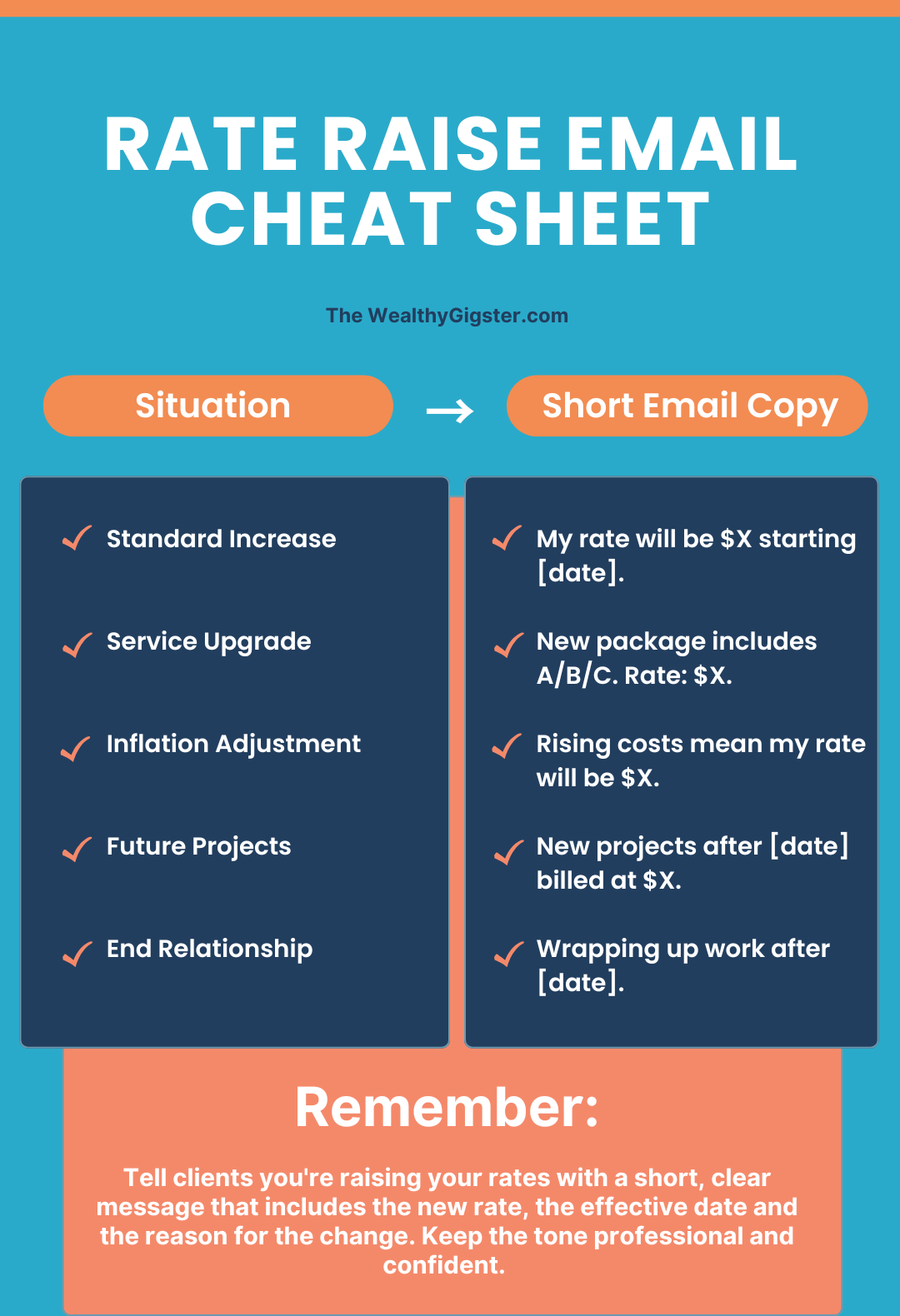
“Starting next month, I’m upgrading my service package. The new rate is $X and includes A/B/C.”
This tactic easily flies under the radar, which is exactly why it works. You’re not asking permission to charge more and you’re not making it a “money conversation.” You’re simply updating how you work, and pricing it accordingly.
That shift in nuance matters. You’re no longer defending a higher price. You’re presenting a better offer. Clients don’t panic over improvements—they panic over unexplained invoices.
When you spell out what’s changing and why it’s better, the rate increase feels reasonable, even expected.
Why This Method Works
You reframe your rate as a service improvement.
Clients see tangible benefits, not just a bigger invoice.
You differentiate yourself from competitors who simply bump prices.
This reframing is how experienced freelancers raise their rates without awkward emails, tense calls or clients suddenly “needing to think about it.”
4. The “Inflation Adjustment” Method
You don’t need to craft a heartfelt message or apologize for existing in an economy where everything costs more. Inflation is objective, measurable and universal — and clients know this.
Here’s the script freelancers swear by:
“Due to rising software, hosting and operational costs, my rate will adjust to $X starting next month.”
Short. Calm. Professional. Done.
Why This Method Works
It removes emotion from the conversation.
Clients already use inflation to explain their own price increases.
It sets a boundary without sounding confrontational.
Among all the options, this is the politest how to raise freelance rates approach — but it’s still firm.
5. The “Fire Your Worst Client” Method
This is the nuclear option for freelancers who are overworked, underpaid or being slowly drained by unreasonable demands. Your worst client is almost always:
Paying the least
Demanding the most
Blocking better opportunities
When you cut them loose, you don’t just get time back — you make room for higher-paying work.
Why This Method Works
You immediately increase your effective hourly rate.
You reclaim bandwidth for better clients.
You reset the standards for how you want to work.
This is the boldest how to raise freelance rates move, but often the most profitable one.
Email Templates
Standard Rate Increase Notice
Warm & Professional
Subject: Updated Rate Effective [Date]

Hi [Name],

Starting on [date], my rate will increase to $X. This reflects the work, results and expanded responsibilities I’m handling across our projects.

If you’d like to discuss scope or upcoming work, I’m happy to chat.

Thank you for your continued partnership.
Direct & Firm
Subject: Updated Rate Effective [Date]

Hi [Name],

My rate will increase to $X, effective [date].

Please let me know if you’d like to continue under the updated pricing structure.

Thank you.
Service Upgrade Offer
Warm & Professional
Subject: Updated Service Package

Hi [Name],

Beginning [date], I’ll be introducing an upgraded service package that includes [A/B/C].

The updated rate will be $X.

Let me know which option best supports your goals.
Direct & Firm
Subject: Service Package Update

Hi [Name],

Starting [date], my service package will include [A/B/C].

The new rate is $X.

Please let me know how you’d like to proceed.
Inflation Adjustment
Warm & Professional
Subject: Rate Adjustment Effective [Date]

Hi [Name],

Due to rising software and operating costs, my rate will adjust to $X, beginning [date].

Thank you for your understanding and continued partnership.
Direct & Firm
Subject: Rate Adjustment

Hi [Name],

My rate will increase to $X, effective [date], to reflect rising business costs.

Please let me know if you have any questions.
New Projects Only
Warm & Professional
Subject: Updated Rate for Future Projects

Hi [Name],

For projects beginning after [date], my rate will be $X.

If you have upcoming work you’d like to schedule before then, feel free to reach out.
Direct & Firm
Subject: Updated Project Rate

Hi [Name],

My rate for all new projects beginning after [date] will be $X.

I look forward to hearing about any upcoming opportunities.
Ending a Client Relationship
Warm & Professional
Subject: Wrapping Up Our Work Together

Hi [Name],

After reviewing my workload and priorities, I’ve decided not to continue taking on new work after [date].

I’ll complete all agreed-upon deliverables and appreciate the opportunity to work together.
Direct & Firm
Subject: Project Conclusion

Hi [Name],

I will not be accepting additional work after [date].

All current commitments will be completed as agreed.

Thank you.
Common Client Objections (and How to Handle Them)
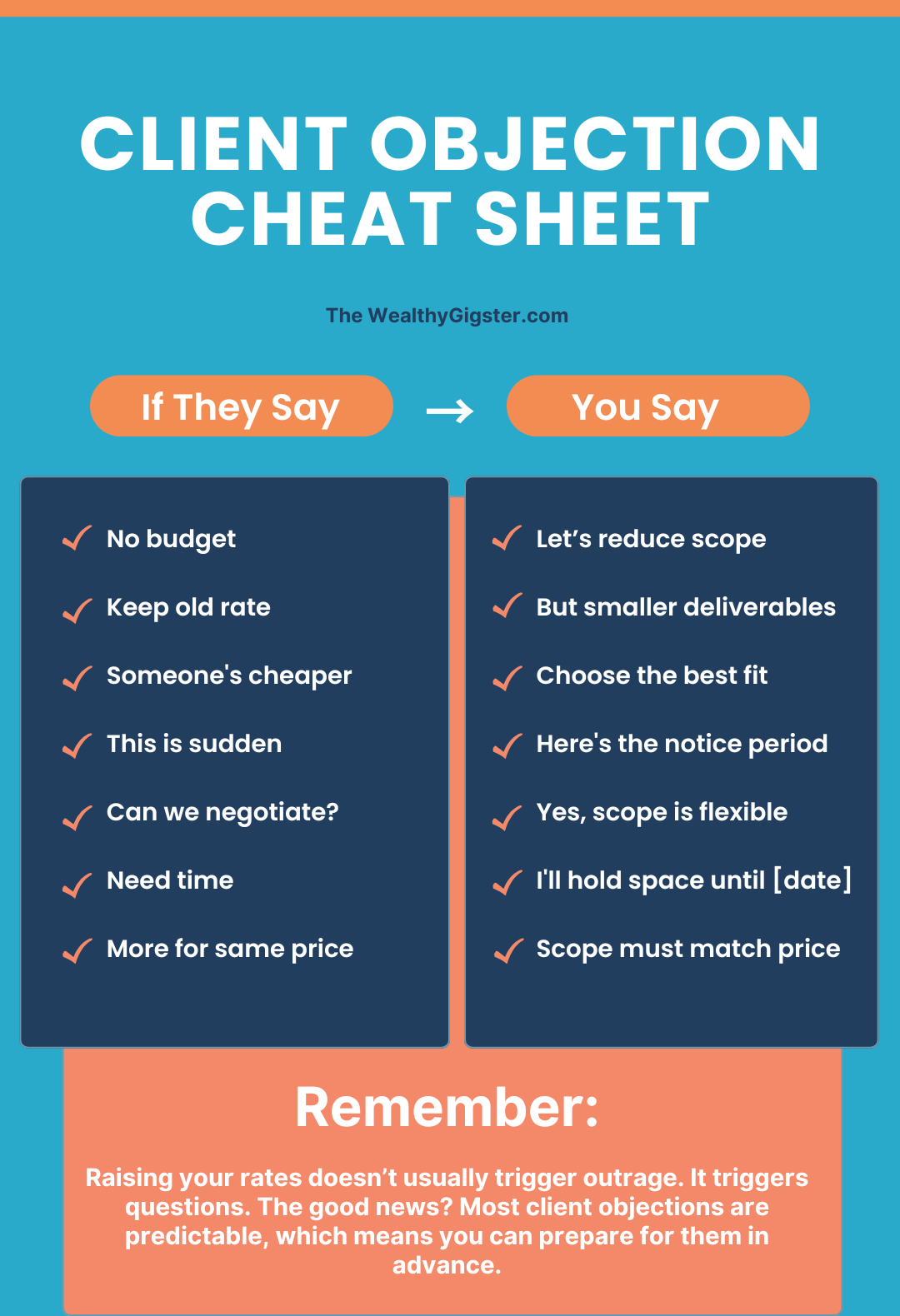
Raising your rates doesn’t usually trigger outrage. It triggers questions. The good news? Most client objections are predictable, which means you can prepare for them in advance.
“We don’t have the budget.”
A budget problem doesn’t automatically mean a relationship problem.
Response: “Totally understand. We can reduce scope to fit your budget or revisit the project when the updated rate works for your team.”
“Can we keep the old rate?”
Clients often ask this first because asking costs them nothing.
Response: “I can keep the current rate if we reduce the scope accordingly. Here are a few options.”
“Another freelancer is cheaper.”
They probably are.
Response: “Absolutely. Rates vary widely. I focus on reliability, results and consistency. Ultimately, you should choose the option that’s the best fit for your goals.”
“This feels sudden.”
Usually this means the client wasn’t expecting the conversation.
Response: “I wanted to provide advance notice so everyone has time to review options and plan accordingly.”
“Can we negotiate?”
Sometimes they’re negotiating. Sometimes they’re simply testing your confidence.
Response: “The rate is firm, but I’m happy to discuss scope adjustments if needed.”
“We need to think about it.”
Fair enough.
Response: “Of course. Take the time you need. I’ll hold availability until [date], after which my schedule may change.”
“Can we get more for the same price?”
The oldest client request in history.
Response: “To maintain the current pricing, the scope would need to remain aligned with it. Here’s what that version looks like.”
When Not to Use How to Raise Freelance Rates Strategies
When you’re mid-project
When you just missed a deadline
When your portfolio is outdated
When you’re relying on that one client for rent
When the economy takes a sudden dip in your niche
Timing matters more than confidence.
There’s an Easier Way to Raise Your Rates With Confidence
Raising your freelance rates gets a lot easier when you can clearly communicate your value, present yourself professionally and show clients exactly what they’re paying for.
The right freelance business tools can help you create polished proposals, manage client relationships, track results and package your services more effectively. When you look and operate like a professional business, higher rates start to feel less like a negotiation and more like a natural next step.
If you’re ready to stop undercharging and start building a more profitable freelance business, these tools can help.
Bonsai earns the top spot because it helps freelancers position themselves like professionals rather than service providers competing on price.
With proposals, contracts, project scopes, invoicing and client management all in one place, Bonsai makes it easier to communicate value, set expectations and justify higher rates. Clients are far more likely to accept a rate increase when they see a structured, professional process behind it.
If you’re serious about raising your rates and attracting better clients, Bonsai is one of the most effective tools available.
Runner-Up: HoneyBook
HoneyBook takes second place because it helps freelancers create a premium client experience from the very first interaction.
From proposals and contracts to client communication and project management, HoneyBook helps you build trust and credibility before pricing ever enters the conversation. That’s important because clients often judge value long before they see your quote.
The only reason it falls behind Bonsai is that Bonsai offers a slightly stronger all-in-one toolkit specifically designed for freelancers.
Frequently Asked Questions (FAQs)
How do I raise freelance rates without losing clients?
The best way to raise freelance rates without losing clients is to communicate the increase clearly, explain the reason behind it and give clients reasonable notice. Most clients are more accepting of rate increases when they understand the value they’re receiving and have time to adjust.
What’s the easiest way to raise freelance rates?
The easiest method is often raising rates only for new clients first. New clients have no expectations based on your previous pricing, allowing you to test higher rates and build confidence before adjusting prices for existing clients.
How often should freelancers raise their rates?
There is no universal schedule, but many freelancers review their pricing every three to six months. A regular value audit can help determine whether your skills, responsibilities, results or operating costs justify a rate increase.
How do I tell clients I’m raising my rates?
Tell clients you’re raising your rates with a short, clear message that includes the new rate, the effective date and the reason for the change. Keep the tone professional and confident. For example, you can say your rate is changing because your responsibilities have expanded, your service package has improved or your operating costs have increased.
Should I raise freelance rates by email or on a call?
Email is usually the better option for raising freelance rates because it gives clients a clear written record of the new rate, timeline and next steps. A call can help if the relationship is complex or high-value, but you should still follow up by email so there is no confusion about the updated pricing.
Should I explain why I’m raising my rates?
Yes, but keep the explanation brief. Anchor the increase to something concrete such as improved results, expanded services, increased demand or rising business costs. Avoid lengthy explanations that make the increase sound negotiable.
What if a client says they can’t afford my new rate?
If a client can’t afford your updated rate, consider reducing the project scope rather than reducing your price. This allows you to maintain your pricing while giving the client a lower-cost option that fits their budget.
When should I avoid raising my freelance rates?
Avoid raising your rates in the middle of a project, immediately after missing a deadline, when your portfolio is outdated or when you’re overly dependent on a single client for income. Timing matters almost as much as the rate increase itself.
Get Smarter with Your Irregular Income
Get free calculators, checklists, planners, worksheets and tips built for freelancers, self-employed workers and independent earners with irregular income.