

Published on June 8, 2026
Written by The Wealthy Gigster Team
Edited by Kevin Nishmas, Managing Editor
Wondering how freelancers build credit without a traditional employer? Whether you’re a freelance writer, designer or photographer, it starts with proving you can manage debt responsibly, even when your income doesn’t arrive as a neat little paycheck every two weeks.
Sure, lenders prefer borrowers with steady employment and a long history of consistent income. But you don’t need a traditional employer and predictable paycheck to build excellent credit. You simply need to understand how credit works and build habits that show lenders you’re financially reliable.
This guide explains exactly how freelancers build strong credit profiles, improve their approval odds and avoid the mistakes that quietly damage credit scores, including how freelancers build credit without a traditional employer in 8 steps.
Table of Contents
- Key Takeaways
- Why Building Credit Feels Harder When You’re Self-Employed
- How Credit Scores Actually Work
- The Biggest Credit Mistakes Freelancers Make
- How Freelancers Build Credit Without a Traditional Employer in 8 Steps
- How Freelancers Improve Their Chances of Getting Approved
- What Lenders Want to See From Freelancers
- How Long Does It Take to Build Credit?
- The Freelancer Credit-Building Checklist
- There’s an Easier Way to Build Credit
- Frequently Asked Questions (FAQs)
- Methodology
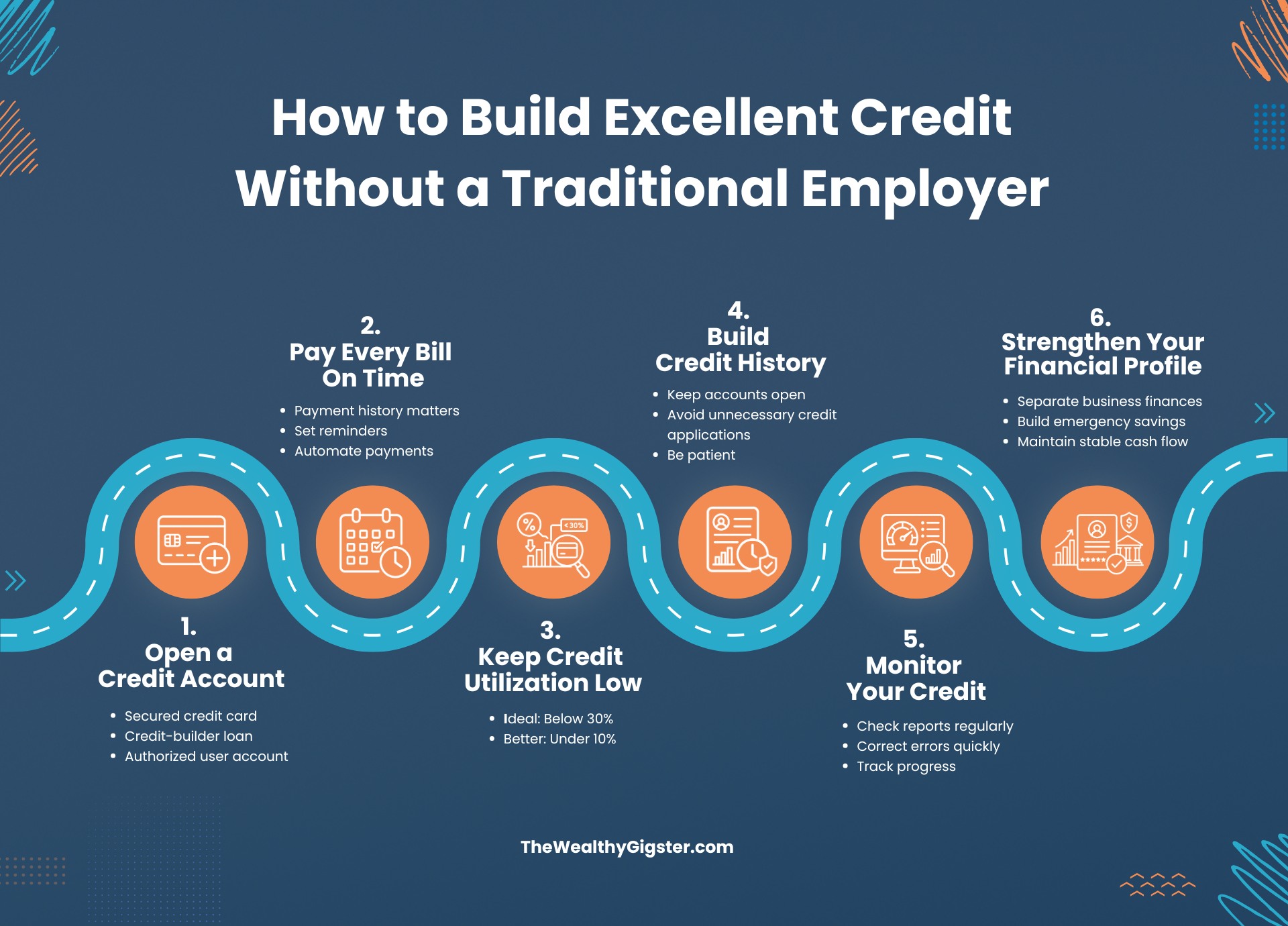
The Freelancer Credit-Building Roadmap
Key takeaways
- Following certain rules is how freelancers build credit without a traditional employer
- Payment history is the single biggest factor affecting credit scores.
- Keeping credit utilization low can improve your score quickly.
- Secured credit cards are often the easiest starting point.
- Credit-builder loans can help establish positive payment history.
- Rent reporting may help strengthen your credit profile.
- Separating business and personal finances supports long-term financial health.
- Strong credit makes it easier to qualify for loans, credit cards and housing.
Why You Can Trust The Wealthy Gigster
We don’t do fluff. And we definitely don’t let advertisers tell us what to say. Every product or service we recommend is vetted using real data, independent research and the financial chaos test: “Would this product or service actually help someone with an irregular income and a rent deadline?”
We rate tools and services based on what matters to gig workers, not 9-to-5ers. If we earn a commission from a partner, you’ll know—but our opinions stay brutally honest, no matter what.
Want the receipts? Check out our About Us, Editorial Standards and Advertising Disclosure pages for how we work and what makes our recommendations worth your time (and money).
Why Building Credit Feels Harder When You’re Self-Employed
Lenders don’t care when your freelance client pays an invoice. They care whether you pay your bills on time. Sad but true.
Ultimately, lenders care whether you look financially dependable. When you’re self-employed, though, your income often fluctuates. One month may look fantastic. The next can look like as bleak as a silent inbox. Traditional lenders often interpret irregular income as risk, even when your business is healthy. That’s why freelancers sometimes feel they’re being punished for choosing independence.
If you want lenders to take you seriously, your credit score needs to do some of the talking for you. The irony is that your credit score ignores how you earn money. It only focuses on how you manage borrowed money. Understanding that difference is the first step in learning how freelancers build credit without a traditional employer.
How Credit Scores Actually Work
Many freelancers assume income determines credit scores. It doesn’t. Credit scores primarily measure how responsibly you manage debt and financial obligations based on a number of well-established factors.
Payment History
Payment history is the biggest credit score factor. Lenders want evidence that you pay off debt on time. Every on-time payment helps your credit score. Every missed payment hurts it.
Credit Utilization
Credit utilization measures how much of your available credit you’re using. For example, if you have a $5,000 limit and carry a $1,000 balance, your utilization is 20%. Most experts recommend staying below 30%. Under 10% is even better.
Credit Age
Older credit accounts, like credit cards or lines of credit, help demonstrate stability. Closing long-standing accounts can sometimes reduce your average credit age and negatively affect your score.
Credit Mix
Credit bureaus generally like seeing different types of credit, including credit cards, loans and other debt obligations managed responsibly.
New Credit Applications
Applying for multiple accounts in a short period can temporarily lower your score. Freelancers should be strategic rather than aggressive when seeking new credit.
The Biggest Credit Mistakes Freelancers Make
Many freelancers accidentally damage their credit while trying to manage unpredictable income.
The most common mistakes freelancers make when building credit:
- Missing payment due dates during slow months
- Carrying high credit card balances
- Maxing out available credit
- Applying for too many credit products
- Ignoring credit reports
- Mixing business and personal expenses
- Using credit cards to fund unsustainable spending
These mistakes can create long-term credit score damage that often takes far longer to repair than it took to create.
How Freelancers Build Credit Without a Traditional Employer in 8 steps
Here’s how freelancers build credit without a traditional employer or any of the outdated advice built for nine-to-fivers..
1. Pay Every Bill On Time
Nothing improves credit faster than consistent, on-time payments. Set up reminders, automatic payments or calendar alerts if necessary. Reliability matters more than perfection.
2. Keep Credit Utilization Low
Using less of your available credit signals financial stability. Even if you pay balances in full every month, keeping utilization low throughout the billing cycle can help your score.
3. Use a Secured Credit Card
Secured credit cards require a refundable deposit that becomes your credit limit. They’re often one of the easiest entry points for freelancers building or rebuilding credit.
4. Become an Authorized User
Being added to a responsible family member’s credit card can help boost your credit score. Only do this if the primary cardholder has excellent payment habits.
5. Use Credit-Builder Loans
Credit-builder loans are specifically designed to help people build credit steadily. These products often report directly to credit bureaus, helping freelancers establish a solid payment record over time. That payment history is a major part of how freelancers build credit without a traditional employer.
6. Report Rent Payments
Rent is often a freelancer’s largest monthly expense. Some services allow rent payments to be reported to credit bureaus, potentially helping strengthen your credit history.
7. Separate Business and Personal Finances
Using separate accounts makes it easier to track cash flow, manage expenses and demonstrate financial organization. It may also simplify future lending applications.
8. Monitor Your Credit Reports
Credit report errors happen more often than most people realize. Review your credit reports regularly and dispute inaccuracies promptly.
How Freelancers Improve Their Chances of Getting Approved
Building credit is only part of the equation. Freelancers can improve their approval odds if they follow these lender-friendly practices:
- Maintaining organized financial records
- Tracking income consistently
- Keeping your tax filings current
- Building a emergency savings fund
- Reducing debt balances
- Avoiding unnecessary credit applications
Lenders like predictability. Your job is to make your finances look as predictable as possible.
What Lenders Want to See From Freelancers
Credit scores get you in the door. The rest of your financial picture helps lenders decide whether to let you in.
What lenders typically look for:
- Strong payment history
- Stable bank account activity
- Low credit utilization
- Reasonable debt levels
- Consistent income trends
- Accurate tax filings
In other words, lenders care less about your job title and more about your financial behavior. Creating a lender-friendly financial profile is how freelancers build credit without a traditional employer.
How Long Does It Take to Build Credit?
Credit building isn’t an overnight project. Most freelancers can see meaningful improvements within six to 12 months of consistently positive credit habits.
Building excellent credit often takes years, but the earlier you start, the sooner you’ll see your credit score go up.
As your score improves, you may gain access to better borrowing options, lower interest rates and easier approvals.
While every lender has its own requirements, most credit scores fall into these ranges:
- 300–579 (Poor): You may struggle to qualify for traditional credit products and often face higher interest rates, security deposits or loan denials.
- 580–669 (Fair): Approval becomes easier, but you’ll likely pay higher interest rates and have fewer lending options than borrowers with stronger scores.
- 670–739 (Good): This is where many freelancers should aim initially. You’ll generally qualify for a wider range of credit cards, loans and financing products at more competitive rates.
- 740–799 (Very Good): Lenders often view you as a lower-risk borrower. You’ll typically have access to better interest rates, higher credit limits and stronger approval odds.
- 800–850 (Excellent): This is the gold standard. Borrowers in this range often qualify for the best available rates, premium credit products and the easiest approval process.
You don’t need a perfect credit score to benefit from good credit. For most freelancers, reaching the Good or Very Good range can open the door to significantly better credit opportunities.
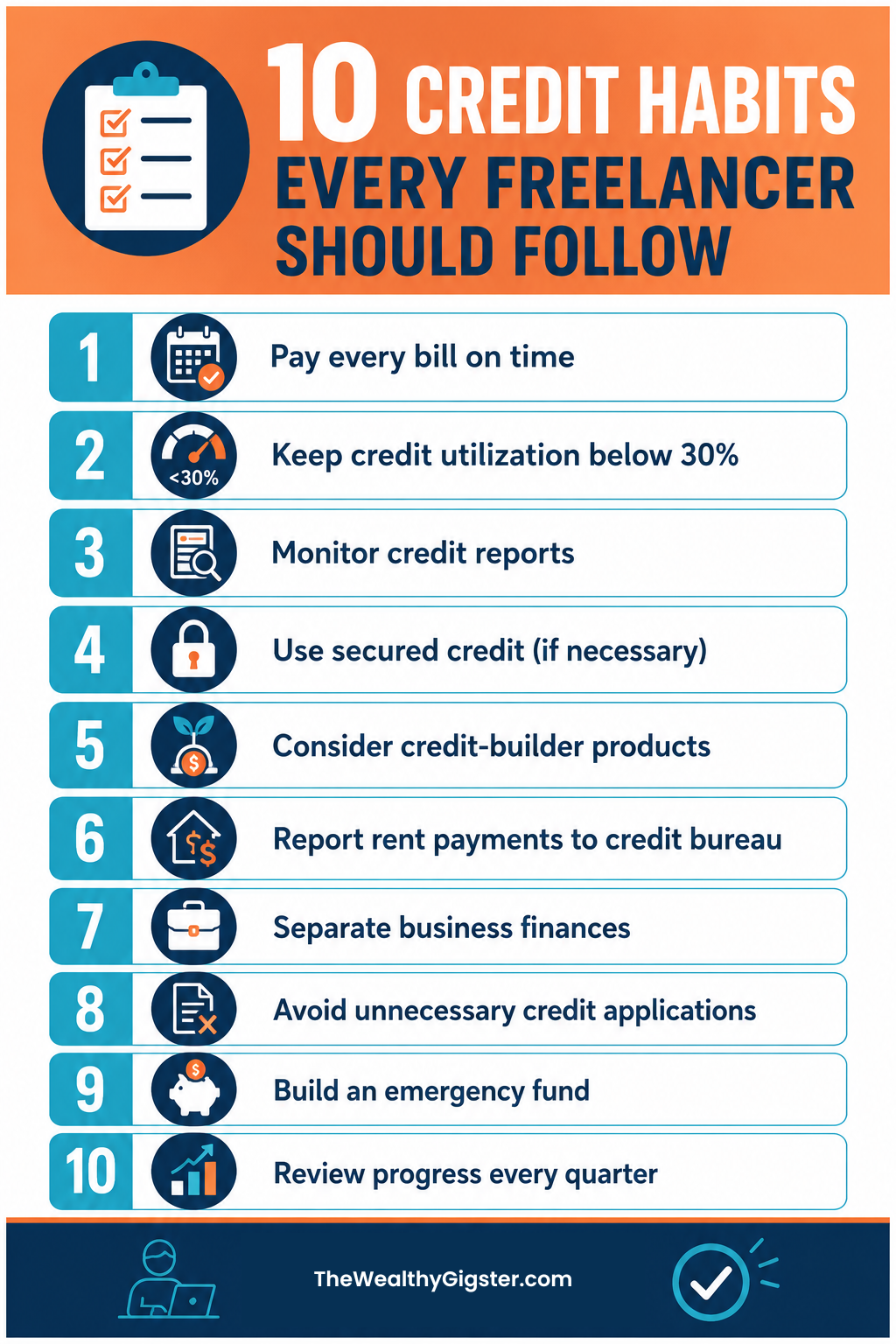
The Freelancer Credit-Building Checklist
Use this checklist as a simple roadmap for how freelancers build credit without a traditional employer. You don’t need to do everything at once. Start with the habits that protect your score, then add tools that help you build stronger credit over time.
There’s an Easier Way to Build Credit
Building credit becomes much easier when you use tools designed to strengthen your payment history, monitor your progress and identify opportunities for improvement.
The tools below can help you, as a freelancer, build credit more efficiently without all the guesswork that comes with trying to decode the rules for improving your credit score on your own.
Self
Self focuses specifically on helping people build credit through credit-builder loans and secured credit products.
Best for: Freelancers building or rebuilding credit.
Pros
- Designed for credit building
- Reports to major credit bureaus
- Easy to understand
- Helps establish payment history
Cons
- Monthly payments required
- Not designed for borrowing large amounts
- Credit growth takes time
Experian
Experian offers credit monitoring tools, credit score tracking and features that may help freelancers strengthen their credit profiles.
Best for: Credit monitoring and score improvement.
Pros
- Free monitoring tools
- Credit alerts
- Score tracking
- Strong educational resources
Cons
- Premium features require payment
- Monitoring alone won’t improve credit
- Some tools vary by location
Credit Karma
Credit Karma provides free access to credit monitoring and educational tools.
Best for: Freelancers who want ongoing visibility into their credit health.
Pros
- Free access
- Easy-to-use dashboard
- Educational resources
- Credit monitoring
Cons
- Credit scores may differ from lender versions
- Product recommendations can be distracting
- Limited advanced features
Our Top Pick: Self
Self earns the top spot because it directly addresses the biggest challenge freelancers face when building credit: establishing a consistently positive payment history.
Rather than simply monitoring your score, Self gives you a structured way to actively build it. The platform is specifically designed for people who need to create or rebuild credit from the ground up.
For freelancers without a traditional employer, that focused approach makes Self one of the most practical credit-building tools available.
Runner-Up: Experian
Experian takes second place because it helps you track your progress, which is half the battle when you’re trying to improve your credit score.
You can’t improve what you don’t measure, and Experian makes it easier to monitor your credit profile, understand changes to your credit score and identify opportunities for improving your credit.
While Experian doesn’t build credit directly like Self, it provides valuable insight into your overall credit health.
Frequently Asked Questions (FAQs)
Can freelancers build credit without a traditional employer?
Yes, credit scores are based primarily on how you manage debt and financial obligations, not where your income comes from. Demonstrating creditworthiness is how freelancers build credit without a traditional employer.
What’s the fastest way for freelancers to build credit?
Making every payment on time and keeping credit utilization low are usually the fastest ways to improve credit scores.
Do lenders treat freelancers differently?
Many lenders require additional income documentation from freelancers, but strong credit can significantly improve your approval odds.
Should freelancers use secured credit cards?
Secured credit cards are often an excellent option for freelancers building or rebuilding credit because approval requirements are generally easier to meet.
Can rent payments help build credit?
In some cases, yes. Certain services report rent payments to credit bureaus, which may help strengthen your credit history.
How long does it take to improve a credit score?
Many people see improvements within six to 12 months of consistently positive financial habits.
Methodology
This article evaluates credit-building strategies based on widely accepted credit-scoring principles, lender expectations and financial best practices commonly used by freelancers, self-employed workers and independent contractors.
Recommendations prioritize accessibility, practicality and long-term financial health rather than quick-fix credit hacks. The goal is to help freelancers build sustainable credit profiles that improve borrowing opportunities, reduce financial stress and support long-term wealth building.
Featured image credit: Photo by Etty Fidele on Unsplash