

Published on June 11, 2026
Written by The Wealthy Gigster Team
Edited by Kevin Nishmas, Managing Editor
Wondering whether you should pay off debt or save money first? If you’re a gig worker, freelancer or independent contractor, the answer isn’t as simple as “pay off your debt as fast as possible.” It’s a little more nuanced than that.
Unlike employees with predictable paycheques, your income may fluctuate wildly from month to month. That changes the math.
In many cases, focusing entirely on debt can leave you one unexpected expense away from creating even more debt. On the other hand, focusing only on savings while carrying high-interest debt can quietly drain your finances.
The smartest approach is usually a combination of both. This guide explains when to prioritize debt, when to prioritize savings and how gig workers can strike the right balance between the two.
Table of Contents
- Key Takeaways
- Pay Off Debt or Save Money First? Do Both, But Not Equally
- Why This Question Matters More for Gig Workers
- When Saving Should Come Before Debt
- When Debt Should Come Before Savings
- The Freelancer Emergency Fund Sweet Spot
- The 3-Step Debt and Savings Framework
- Common Mistakes Gig Workers Make
- Should You Invest Before Paying Off Debt?
- There’s an Easier Way to Balance Debt and Savings
- Frequently Asked Questions (FAQs)
- Methodology
Key takeaways
- Most gig workers should build a small emergency fund before aggressively paying down debt.
- High-interest debt often deserves immediate attention.
- A starter emergency fund can prevent future borrowing.
- Income volatility changes the debt-versus-savings equation.
- Building savings and paying debt simultaneously is often the best long-term strategy.
- The goal isn’t choosing one or the other forever. It’s knowing which deserves priority right now.
- Financial stability matters more than financial perfection.
- A small cash buffer can prevent much bigger money problems.
Why You Can Trust The Wealthy Gigster
We don’t do fluff. And we definitely don’t let advertisers tell us what to say. Every product or service we recommend is vetted using real data, independent research and the financial chaos test: “Would this product or service actually help someone with an irregular income and a rent deadline?”
We rate tools and services based on what matters to gig workers, not 9-to-5ers. If we earn a commission from a partner, you’ll know—but our opinions stay brutally honest, no matter what.
Want the receipts? Check out our About Us, Editorial Standards and Advertising Disclosure pages for how we work and what makes our recommendations worth your time (and money).
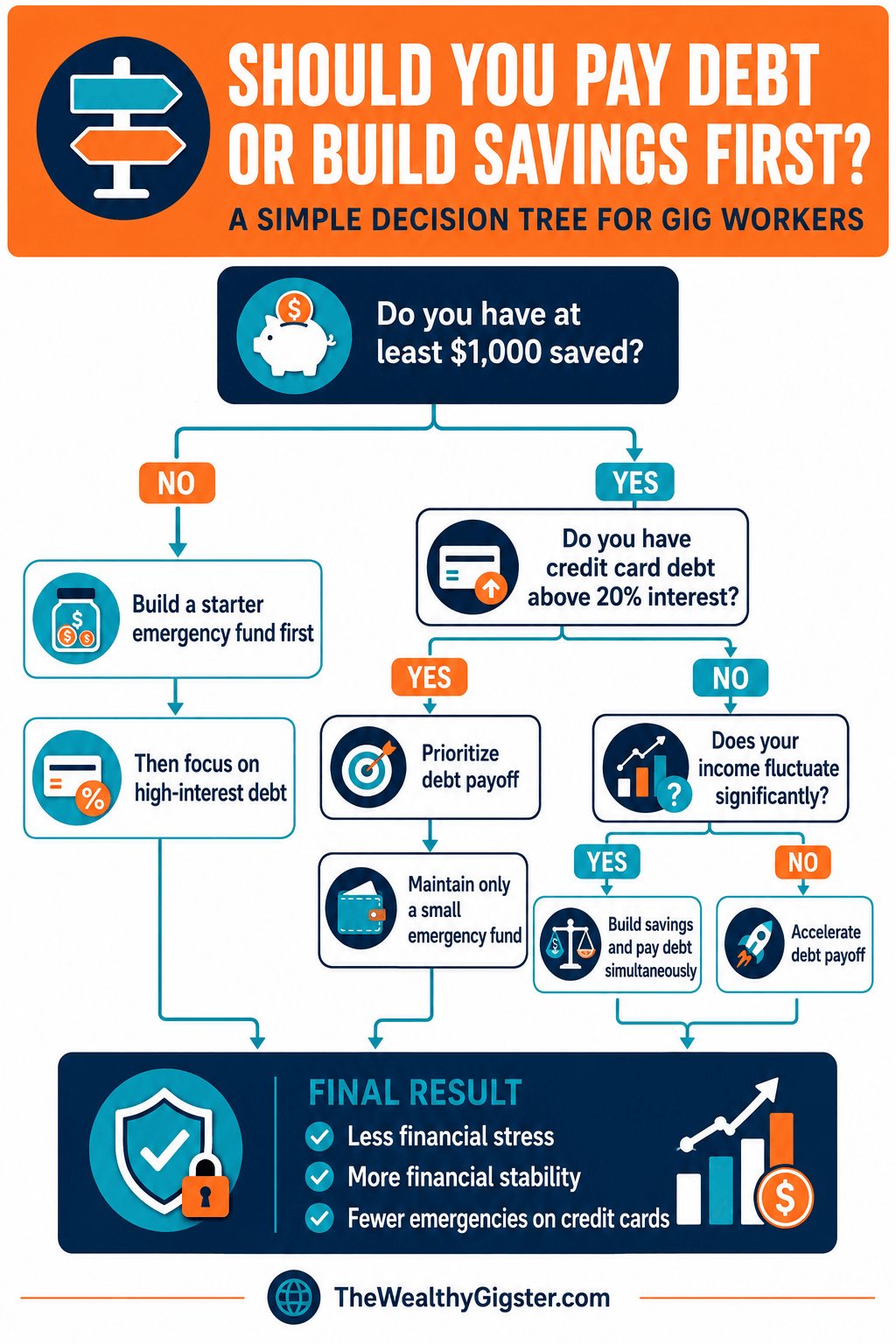
Pay Off Debt or Save Money First? Do Both, But Not Equally
Most traditional personal finance advice treats debt and savings like opposing teams. Pay off debt first. No, save first. No, invest first. For gig workers, the answer is usually more nuanced.
If your income changes every week, wiping out your savings to attack debt can backfire quickly. One car repair, one slow month or one surprise expense can send you right back to your credit cards. Likewise, stockpiling cash while carrying expensive debt can cost you hundreds or even thousands of dollars in interest.
That’s why most freelancers should focus on both debt and savings, but not necessarily in equal amounts. The right balance depends on your debt, your income stability and your financial safety net.
Why This Question Matters More for Gig Workers
Traditional financial advice assumes a steady paycheque will arrive every week or every two weeks. Gig workers don’t have that luxury. One month may be packed with projects, clients or deliveries. The next may feel like your gig apps collectively decided to take a vacation.
When income is unpredictable, emergencies hit differently. A salaried employee can absorb a surprise expense with next week’s paycheque. A freelancer may need months to recover.
That’s why building some savings often becomes a higher priority for gig workers than it might be for traditional employees. In other words, financial resilience matters when you’re a gig worker or freelancer and your income doesn’t follow a set schedule.
When Saving Should Come Before Debt
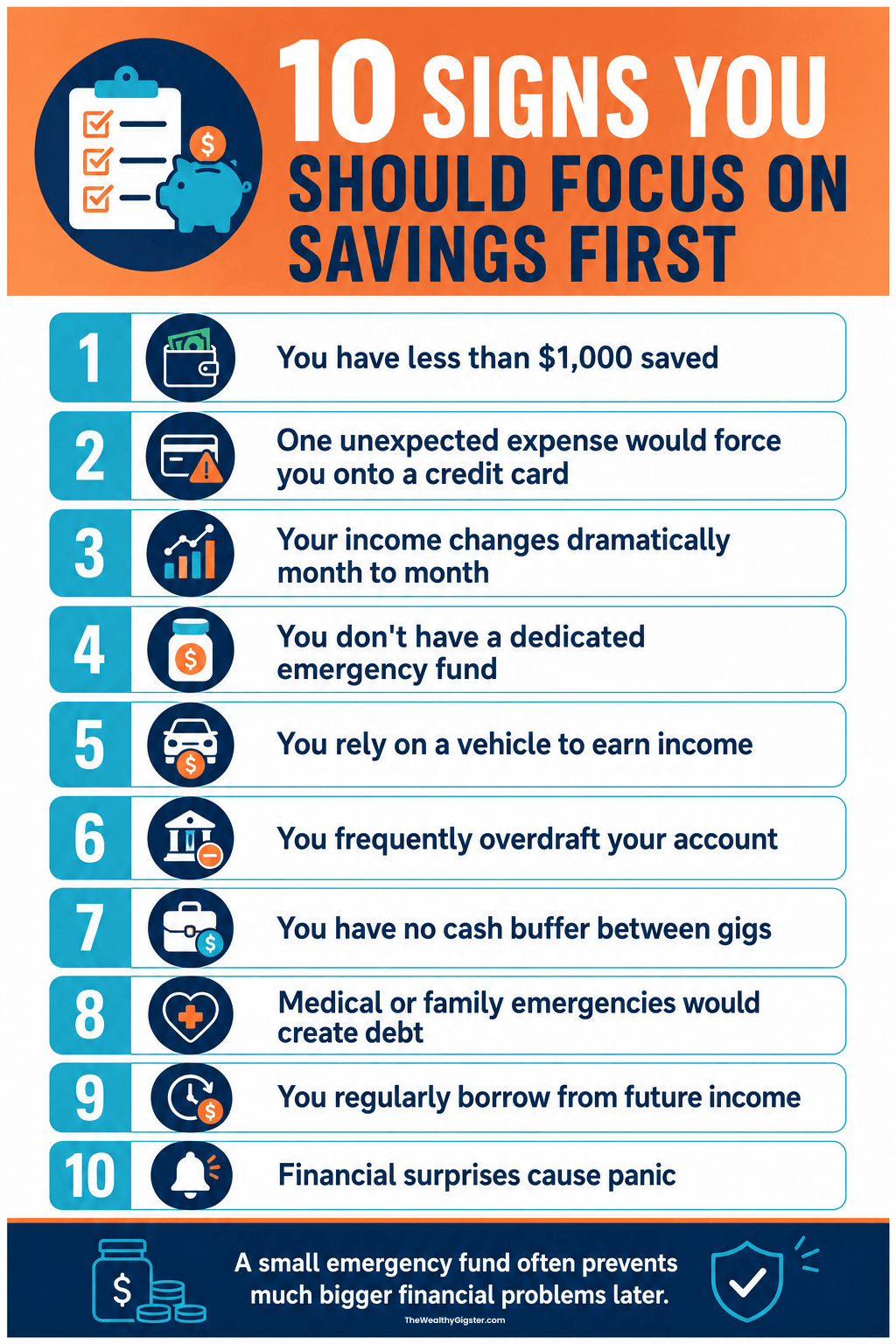
For gig workers, debt isn’t always the biggest financial risk. Sometimes the bigger problem is having no cash available when life throws you a curveball. In certain situations, building savings first is the smarter move.
You Have No Emergency Fund
If your emergency fund currently contains little more than good intentions, start there. Even a modest cash buffer can prevent a financial setback from becoming a debt spiral. Most freelancers should aim to build at least a starter emergency fund before aggressively attacking debt.
Your Income Changes Every Month
Irregular income creates financial uncertainty. Savings help smooth out fluctuations in your income. Without savings, slow periods often force freelancers to rely on credit cards, personal loans or other expensive borrowing options.
You Depend on One Vehicle or Piece of Equipment
Many gig workers rely on a car, laptop, phone, camera or specialized equipment to earn income. If that equipment fails and you have no savings, debt becomes your emergency plan. That’s not a position you want to be in.
You Regularly Use Credit Cards for Emergencies
If every surprise expense ends up on a credit card, you don’t have a debt problem. You have a savings problem. Building even a modest emergency fund can help break this cycle and reduce future borrowing.
When Debt Should Come Before Savings
Savings matter, but some debt grows so fast that waiting can cost you more than it protects you. If interest, fees or minimum payments are eating your income alive, debt may be the financial emergency.
High-Interest Credit Card Debt
Credit card interest rates often exceed 20%. If you’re carrying large balances, that interest can quietly erase your financial progress. Every month you delay paying off high-interest debt, it becomes exponentially more expensive.
Payday Loans
Payday loans should generally move to the front of the line. The interest rates and fees for these loans can be financially devastating. Eliminating them quickly often delivers one of the best financial returns available.
Persistent Carrying Balances
If you’re only making minimum payments and your credit card or line of credit balances never seem to shrink, debt should become a priority. Interest can turn small balances into long-term financial burdens.
Debt Growing Faster Than Savings
If your debt is accumulating interest faster than your savings are growing, it may make sense to direct more money toward repayment. Otherwise, you can end up running hard financially while standing still.
The Freelancer Emergency Fund Sweet Spot
One of the biggest mistakes freelancers make is thinking they need a fully funded emergency fund before paying down debt. That’s rarely necessary.
What a more practical approach looks like:
- Build a starter emergency fund of $1,000 to $2,000.
- Focus aggressively on high-interest debt.
- Return to savings once expensive debt is under control.
This protects your financial health without preventing you from paying off your debt gradually. Think of it as building a financial shock absorber before accelerating toward debt freedom.
The 3-Step Debt and Savings Framework
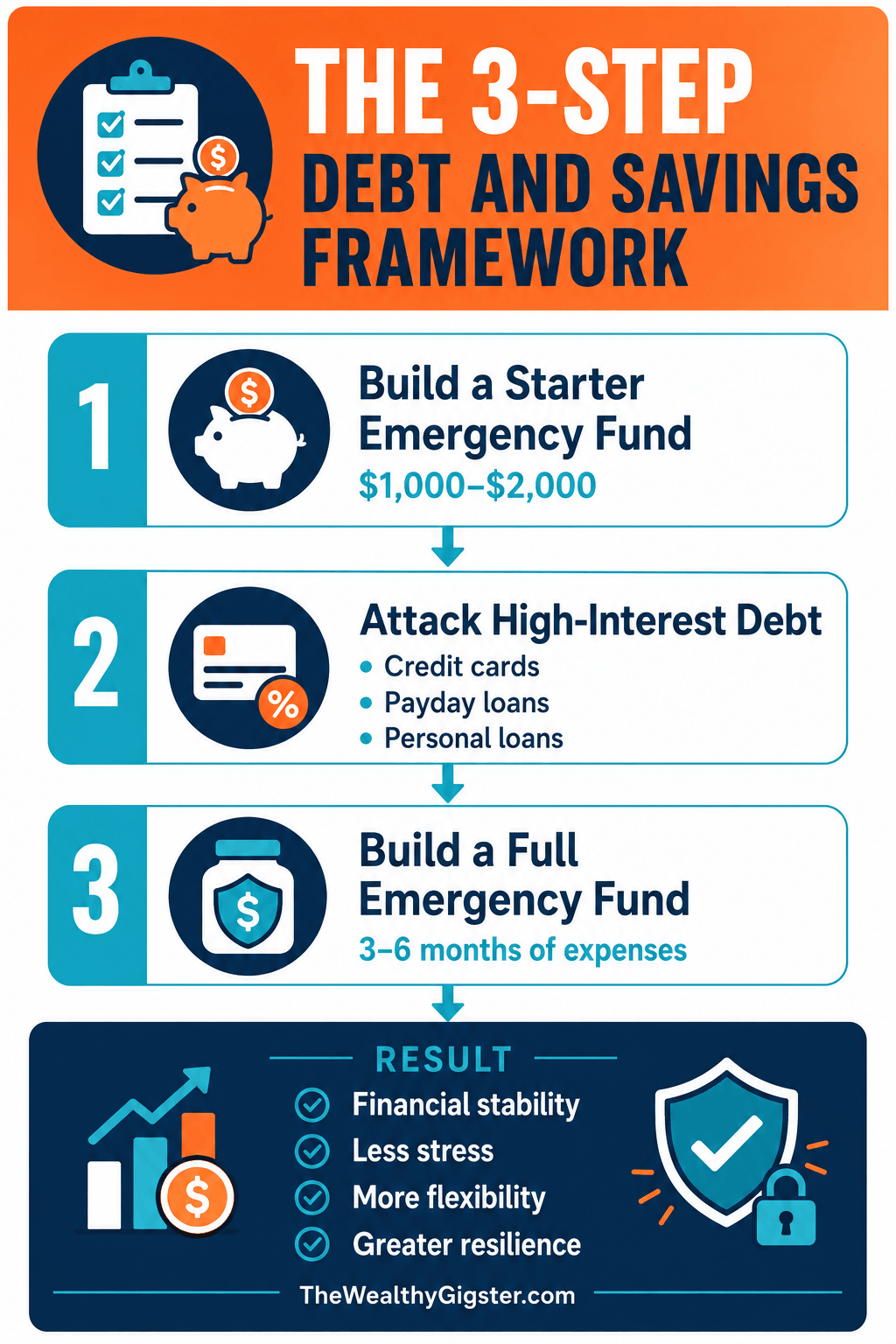
When money is tight, trying to save, pay off debt, cover bills and plan ahead all at once can feel impossible. This 3-Step Debt and Savings Framework gives you a simple way to protect yourself first, attack expensive debt next and finally build a bigger safety net.
If cash is especially tight, start by figuring out what bills to pay first when broke, then use this framework for debt and savings.
Step 1: Build a Starter Emergency Fund
Aim for enough cash to handle small emergencies without borrowing. For many freelancers, $1,000 to $2,000 is a reasonable starting target. The goal isn’t perfection. The goal is protection.
Step 2: Attack High-Interest Debt
Once your starter fund exists, focus on debt with the highest interest rates. Credit cards and payday loans usually belong at the top of the list. Every balance you eliminate improves both cash flow and financial flexibility.
Step 3: Build a Full Emergency Fund
After expensive debt is under control, shift your focus back to savings. Most freelancers should eventually work toward three to six months of essential expenses. Gig workers with highly unpredictable income may benefit from an even larger buffer.
Common Mistakes Gig Workers and Freelancers Make
Many gig workers, freelancers and independent contractors accidentally make their financial situation harder than it needs to be.
The most common mistakes they make:
- Paying off debt while keeping no cash buffer
- Saving aggressively while ignoring high-interest debt
- Using credit cards as an emergency fund
- Failing to budget for irregular income
- Ignoring minimum debt payments
- Borrowing against future income
- Treating good months as permanent
Financial stability usually comes from consistency, not extreme decisions.
Should You Invest Before Paying Off Debt?
Usually, no. If you’re carrying high-interest debt, the guaranteed savings from eliminating that interest often outweigh potential investment returns.
For example, paying off a credit card charging 24% interest effectively gives you a risk-free 24% return. Few investments can reliably match that. However, once high-interest debt is under control and a basic emergency fund exists, investing becomes a much stronger option.
When deciding where each dollar should go, gig workers and freelancers should focus on their financial priorities in the following order:
- Build a starter emergency fund ($1,000–$2,000)
- Pay off high-interest debt (especially credit cards and payday loans)
- Build a full emergency fund (three to six months of essential expenses)
- Invest for long-term goals (retirement and wealth building)
Following this sequence can help gig workers and freelancers build stability without sacrificing future wealth.
There’s an Easier Way to Balance Debt and Savings
Deciding where every dollar should go can feel overwhelming when your income changes constantly. The right financial tools can help you prioritize spending, track progress and make smarter decisions about debt and savings without relying on guesswork.
If you’re trying to build financial stability while juggling irregular income, the tools below can help you.
YNAB (You Need A Budget)
YNAB helps freelancers assign every dollar a job, making it easier to decide how much should go toward debt, savings and everyday expenses.
Best for: Gig workers and freelancers who want a clear plan for balancing debt payoff and emergency savings.
Pros
- Built around intentional money allocation
- Excellent for irregular income
- Helps prioritize financial goals
- Strong educational resources
Cons
- Monthly subscription required
- Learning curve for new users
- More hands-on than some budgeting apps
Rocket Money
Rocket Money helps uncover extra money by tracking spending, identifying subscriptions and highlighting opportunities to reduce expenses.
Best for: Freelancers who need to free up more cash for debt payoff or savings.
Pros
- Easy-to-use dashboard
- Subscription tracking
- Spending insights
- Bill negotiation features
Cons
- Some premium features cost extra
- Savings depend on user action
- Not designed specifically for freelancers
Monarch Money
Monarch Money provides a complete view of your finances, helping freelancers track cash flow, debt balances and savings goals in one place.
Best for: Freelancers managing multiple income streams.
Pros
- Comprehensive financial dashboard
- Goal tracking
- Cash flow monitoring
- Strong account aggregation
Cons
- Subscription required
- Can feel overwhelming initially
- Fewer debt-specific features
Our Top Pick: YNAB
YNAB earns the top spot because it’s designed to show exactly where should your next dollar go.
Instead of focusing only on budgeting, YNAB helps freelancers actively assign money to competing priorities such as debt repayment, emergency savings, taxes and everyday expenses.
For gig workers with unpredictable income, that flexibility can be invaluable.
The platform also encourages intentional decision-making, which helps reduce the emotional stress that often comes with choosing between debt and savings.
If you’re looking for a tool that directly supports the strategy discussed in this article, YNAB is the strongest fit.
Runner-Up: Rocket Money
Rocket Money takes second place because finding extra money is often half the battle. Many freelancers don’t have a debt problem or a savings problem. They have a cash-flow problem.
Rocket Money helps uncover opportunities to free up money through spending analysis, subscription tracking and bill management.
The more money you can redirect from unnecessary expenses, the easier it becomes to build savings and pay down debt simultaneously.
Frequently Asked Questions (FAQs)
Should you pay debt or build savings first?
For most gig workers, the best answer is both. Start by building a small emergency fund, then focus aggressively on high-interest debt before returning to larger savings goals.
How much emergency savings should freelancers have before paying off debt?
Many financial experts recommend building a starter emergency fund of roughly $1,000 to $2,000 before prioritizing high-interest debt repayment.
Should I save money while paying off credit card debt?
Usually, yes. Maintaining at least a modest emergency fund can help prevent new credit card debt when unexpected expenses occur.
What debt should I pay off first?
In most cases, focus on debt with the highest interest rate first. Credit cards and payday loans typically deserve top priority.
Can gig workers have a smaller emergency fund?
Generally, no. Because freelance income is less predictable, many gig workers actually benefit from larger emergency funds than traditional employees.
Should I invest before paying off debt?
Usually not if you’re carrying high-interest debt. The guaranteed savings from eliminating expensive interest often exceed potential investment returns.
What if I can’t save and pay debt at the same time?
Focus on building a small emergency fund first. Once that’s established, direct most available cash toward high-interest debt while maintaining your savings buffer.
Methodology
This article evaluates debt repayment and savings strategies through the lens of gig worker finances, irregular income and real-world cash-flow management.
The recommendations prioritize financial resilience over theoretical optimization. While paying off debt quickly is often mathematically ideal, freelancers face unique risks related to income volatility, inconsistent workloads and unexpected expenses.
As a result, this framework balances debt reduction with emergency preparedness to help gig workers reduce financial stress, improve stability and avoid relying on expensive borrowing during difficult periods.
Featured image credit: Photo by Mason Wilkes on Unsplash